

INTERNATIONAL
UK Professor Visits IAE of CAS, Shares Insights Into Long-Term Forest Carbon Cycling Under Rising CO2 Levels
Sami Ullah, a professor at the University of Birmingham in the United Kingdom, visited the Institute of Applied Ecology (IAE) of the Chinese Academy of Sciences (CAS) in Shenyang, Liaoning province, from Nov. 3 to 5, where he toured a field research station of IAE and gave an academic talk on how mature forests respond to rising atmospheric carbon dioxide (CO2) concentrations.
The visit was jointly organized by the institute's Innovation Group on Ecosystem Carbon and Nitrogen Cycling and Stable Isotope Techniques and the CAS Key Laboratory of Forest Ecology and Conservation.
On Nov. 4, Ullah visited the Qingyuan Forest Ecosystem National Field Observation and Research Station in Liaoning province. Accompanied by YU Lizhong, deputy head of the station, and other researchers, he toured the station's exhibition hall to learn about its development, research priorities and scientific achievements. He also inspected its field research facilities, including the hydrological monitoring network, eddy covariance observation platforms, warming experiment facilities and nitrogen addition experimental plots. During the field visit, Ullah exchanged views with researchers on experimental design, plot arrangements and ongoing research. He spoke highly of the station's research and long-term monitoring capabilities and offered suggestions for improving several experimental programs.
On Nov. 5, Ullah gave a talk titled "Carbon and Nutrient Cycling Responses to 10 Years of Free Air CO2 Enrichment of a Mature Temperate Forest, UK." Using findings from the Birmingham Institute of Forest Research Free-Air CO2 Enrichment (BIFoR FACE) experiment at the University of Birmingham, he discussed how mature forest ecosystems respond to elevated atmospheric CO2 concentrations and what these responses mean for terrestrial carbon sinks under global climate change.
Ullah highlighted the importance of long-term field experiments in understanding forest carbon cycling and assessing the potential of terrestrial ecosystems to absorb and store carbon. Findings from the BIFoR FACE experiment showed that elevated CO2 concentrations significantly stimulated tree growth in mature forests. However, the magnitude of this response varied considerably from year to year, underscoring the importance of long-term observations in identifying cumulative effects that may not be apparent in individual years.
He also emphasized that forest responses to rising CO2 levels are shaped by interactions between plant physiological processes and environmental and biological stressors, including drought and insect herbivory. Such pressures can offset some of the growth benefits associated with elevated CO2, thereby affecting the capacity of forests to function as carbon sinks.
Ullah also discussed how rising CO2 concentrations may affect belowground carbon allocation, root exudation and rhizosphere priming effects. Ullah stressed the importance of interactions between plants and soil microorganisms in regulating forest carbon cycling, highlighting the need to consider aboveground and belowground processes together when evaluating ecosystem responses to global change.
More than 50 early-career researchers and graduate students from the IAE, including LÜ Xiaotao, LI Hui, WANG Chao, KANG Ronghua, YAN Tao, ZHANG Weidong, XU Sheng, QUAN Zhi and YIN Liming, attended the talk. LIU Dongwei, an associate research fellow at the institute, chaired the event.
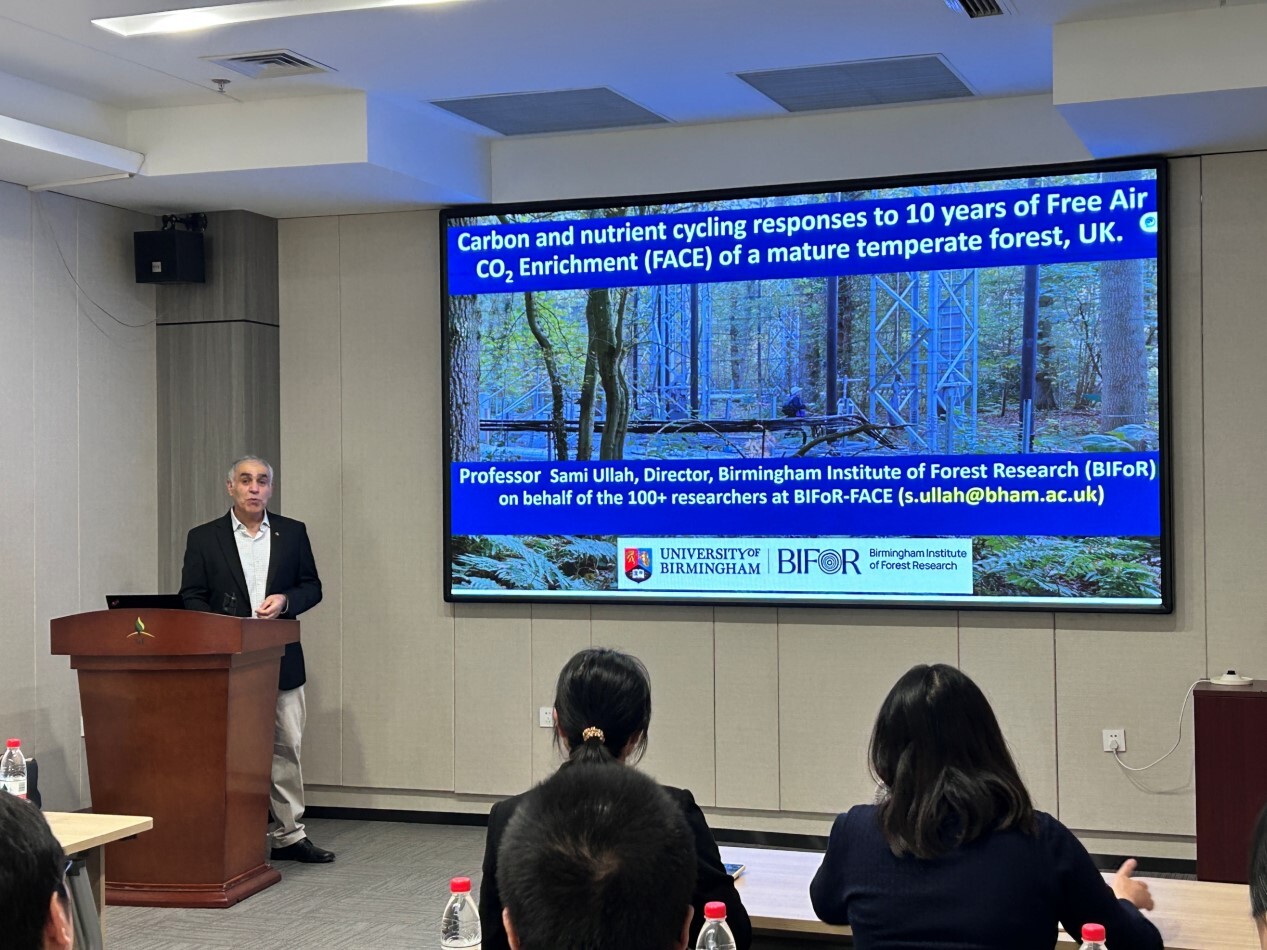
Figure 1. Sami Ullah gives an academic talk at the Institute of Applied Ecology of the Chinese Academy of Sciences.
