

News
Bamboo Industry Development Discussed at Seminar in Huitong
Researchers, government officials and industry representatives gathered in Huitong county, Hunan province, on May 20 for a seminar on bamboo-based alternatives to plastics, a national initiative aimed at reducing plastic pollution and promoting sustainable use of bamboo resources.
The event was jointly organized by the Huitong Forest Ecosystem Research Station of the Chinese Academy of Sciences and the Huitong County Forestry Bureau. More than 20 county-level government departments, township officials, members of the local bamboo industry association, and faculty and students from the research station attended the seminar.
QI Lianghua, director of the Bamboo and Rattan Resources and Environment Research Institute of the International Bamboo and Rattan Organization (INBAR), was invited to deliver a keynote presentation. He reviewed the background of China's Bamboo as a Substitute for Plastic initiative, noting that China possesses abundant bamboo resources, with approximately 128 million mu (about 8.5 million hectares) of bamboo forests and tens of thousands of bamboo-based products already in use.
According to Dr. QI, growing concerns over plastic pollution have elevated bamboo substitution from an environmental concept to a national development strategy. He noted that significant progress has been made in recent years in areas including policy support, technological innovation, platform development, technology transfer and application, standards development and carbon assessment.
Dr. QI also outlined major trends shaping the sector's future development. He emphasized the importance of stronger policy support at different levels of government, broader dissemination of successful practices, continued technological innovation, expansion of bamboo product applications, and the establishment of collaborative mechanisms linking government, industry, universities, research institutes, end users, finance and innovation service providers.
Addressing the development of Huitong's bamboo industry, Dr. QI recommended setting development goals based on local conditions, identifying key constraints facing the sector, strengthening cooperation with local research institutions such as the Huitong station in monitoring and evaluation, and promoting coordinated development across the entire industrial chain, from bamboo cultivation and processing to downstream services and market applications.
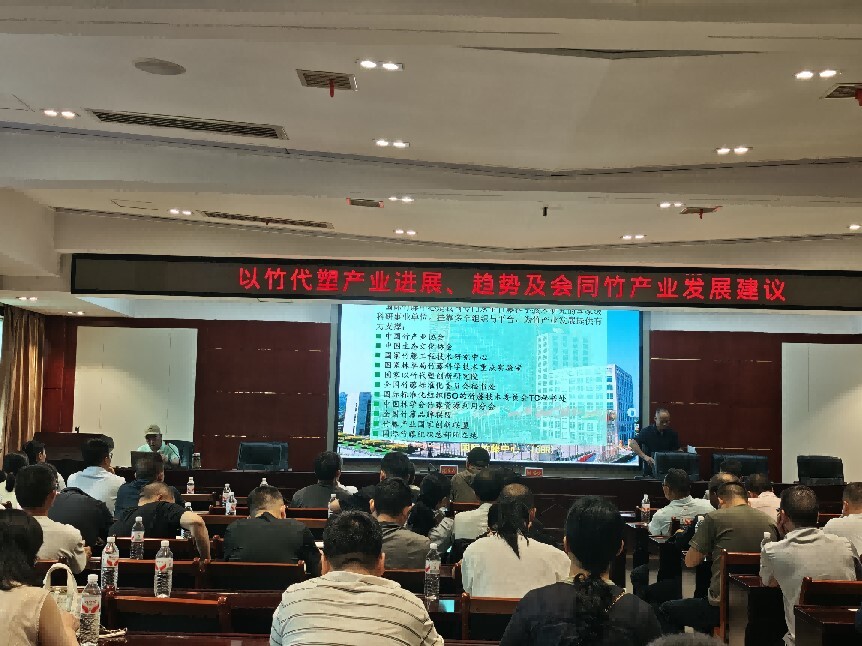
Figure 1. QI Lianghua speaks at a seminar on bamboo-based alternatives to plastics in Huitong county.
