

News
Liaoning Province China-US International Joint Laboratory on Climate-Smart Forestry Established
Liaoning Province China-US joint laboratory focusing on climate-smart forestry was launched on Aug 31 at the Qingyuan Forest Ecosystem Observation and Research Station, marking a new step in international collaboration on forest ecology, carbon monitoring and climate change research.
The joint laboratory was inaugurated at the Qingyuan National Field Observation and Research Station for Forest Ecosystems, operated by the Institute of Applied Ecology (IAE) of the Chinese Academy of Sciences (CAS).
The inauguration ceremony was attended by WANG Maohua, deputy director-general of the Liaoning Provincial Department of Science and Technology, ZHU Jiaojun, director of IAE, SUN Tao, deputy director of IAE, YU Lizhong, deputy head of the Qingyuan Forest Station, and GAO Tian, head of the information center of IAE, among others.
During the event, participants visited the station’s history exhibition hall and laboratories, where Yu introduced the station’s development, research focus, infrastructure, scientific achievements and future plans. GAO outlined challenges facing traditional forestry and forest ecology research, as well as the development of climate-smart forestry approaches. Gao highlighted how climate-smart forestry technologies, supported by digitalization, networking and intelligent systems, could transform traditional research and forest management practices by improving data collection, simulation analysis and decision-making. Researchers and officials also discussed key areas for the joint laboratory, including forest carbon sink assessment, carbon emission accounting, 3D forest structure analysis, data center development and organizational management.
ZHU and WANG jointly unveiled the nameplate of the Liaoning Province China-US International Joint Laboratory on Climate-Smart Forestry, officially bringing the facility into operation. SUN Tao presided over the unveiling ceremony.
Following the ceremony, participants visited key research facilities at the Qingyuan Forest Station, including the forest watershed hydrological monitoring station, eddy covariance observation towers and long-term observation plots. ZHU and other researchers introduced the design and ongoing studies associated with the observation platforms and exchanged views on related scientific issues.
Initiated by ZHU, the joint laboratory began preparation in March 2026. It adopts a dual-director management model, with ZHU serving as the Chinese director and Professor WANG Gaofeng from Clemson University in the United States serving as the international director. The laboratory’s daily operations will be supported by the Information Center of the Institute of Applied Ecology, CAS. The laboratory aims to bring together international research institutions in related fields and use digital, networked and intelligent technologies to advance understanding of interactions between forest ecosystems and climate change. It will also seek to develop a systematic framework for forest carbon sink monitoring and assessment, contributing to global carbon governance and China’s carbon neutrality goals.
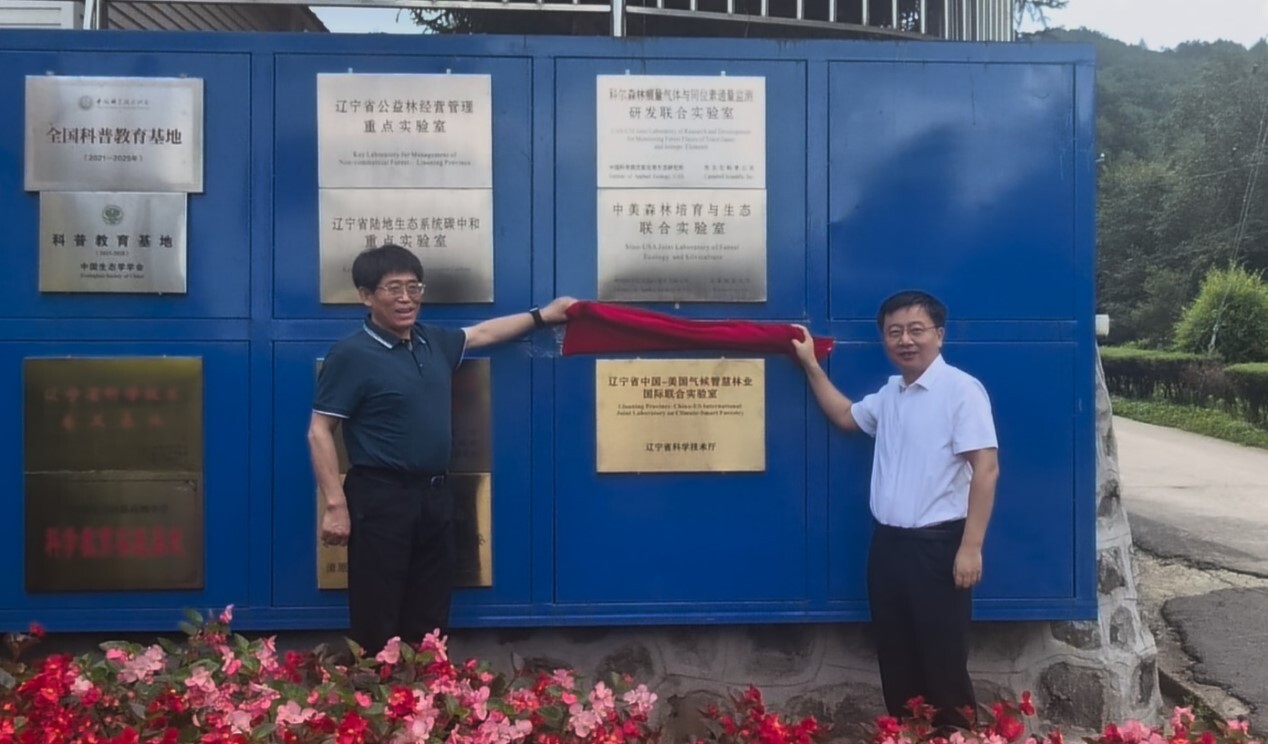
Figure 1. ZHU Jiaojun and WANG Maohua jointly unveil the plaque of the Liaoning China-US International Joint Laboratory on Climate-Smart Forestry
