RESEARCH NEWS
Long-term Trial Identifies Source–Sink Synergistic Regulation Pathways Linking Soil Fertility and Maize Yield under Straw Mulching
Researchers from the Institute of Applied Ecology of the Chinese Academy of Sciences have clarified how no-tillage combined with straw mulching links soil fertility and maize yield over time, based on a 15-year field experiment in Northeast China.
The study, co-led by Dr BAO Xuelian, Dr HE Hongbo, Dr XIE Hongtu, and Dr ZHANG Xudong, was published in Field Crops Research.
Conservation tillage practices such as no-tillage and straw mulching are widely used to reduce soil disturbance, increase external carbon inputs, and improve soil physical and chemical properties. Straw mulching refers to the practice of leaving crop residues on the field surface after harvest, which can enhance soil organic matter and moisture retention. While these practices are known to benefit agricultural sustainability, the internal pathways linking soil conditions, plant physiological processes, and yield formation remain insufficiently understood, particularly under varying levels of straw input. The balance between improving soil fertility and maximizing crop yield has also remained unclear.
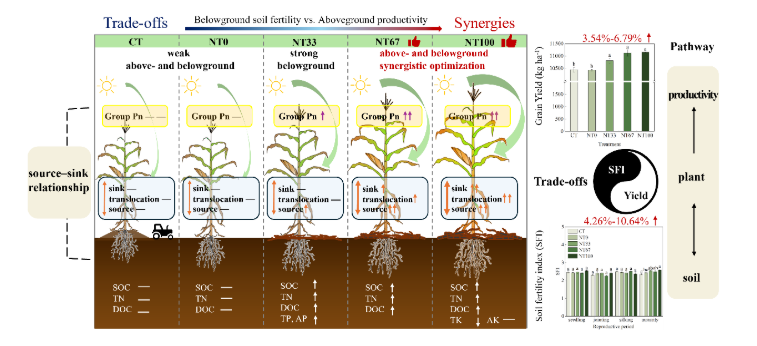
To address these issues, the research team analyzed the experiment established in the black soil region of Northeast China. They quantified changes in soil fertility index, maize canopy net photosynthetic rate, and carbon and nitrogen allocation between source and sink organs. In plant physiology, source organs typically refer to leaves that produce assimilates through photosynthesis, while sink organs such as grains and roots consume or store these products. Source strength describes the capacity of plants to produce photosynthates, whereas sink capacity reflects the ability to utilize or store them.
The researchers found that no-tillage combined with straw mulching significantly improved the cascade pathway linking soil, plant, and productivity compared with conventional tillage. Soil fertility, photosynthetic performance, source strength, and the efficiency of carbon and nitrogen translocation all increased, ultimately contributing to higher maize yields. These effects showed a clear dependence on the amount of straw returned to the field, with overall improvements becoming more pronounced as mulching levels increased.
From the perspective of source–sink dynamics, through which changes in soil fertility influence yield formation, the researchers reported that both conventional tillage and no-tillage without straw return were constrained by simultaneous limitations in source supply and sink capacity, restricting yield formation. Under no-tillage with a low level of straw mulching, yield formation was primarily limited by sink capacity. In contrast, higher levels of straw mulching promoted source-sink synergy, removing major physiological constraints and supporting greater photosynthetic capacity and more efficient biomass allocation, leading to sustained yield increases.