

RESEARCH NEWS
Study Defines Organic Fertilizer Substitution Limits and Trade-offs in Smallholder Farming Systems
Researchers from the Institute of Applied Ecology of the Chinese Academy of Sciences have quantified the extent to which organic fertilizers can replace chemical inputs in smallholder farming systems, and how different organic recycling models affect both nutrient efficiency and farm income.
The study, co-led by Dr NING Yu, Dr YU Wantai, and Dr MA Qiang, was published in the European Journal of Agronomy.
Chemical fertilizers have played a central role in supporting global food production, yet their excessive use has contributed to non-point source pollution and soil degradation. Organic fertilizers, including livestock manure and composted crop residues, are widely regarded as a means to maintain soil fertility and reduce environmental risks. In smallholder-dominated agricultural systems in China, crop production and livestock rearing are often closely linked, forming the basis for nutrient recycling. However, the supply of organic materials is constrained by farm productivity and nutrient management practices, meaning that organic substitution cannot increase indefinitely. Determining the substitution threshold, defined as the maximum proportion of chemical fertilizer that can be replaced by organic inputs without compromising crop yields, remains a key issue for sustainable agriculture.
To address this, the researchers conducted a 34-year field experiment at the Shenyang Agroecosystem National Field Research Station in Liaoning province. They compared two representative organic recycling models under four fertilization regimes combining organic and mineral fertilizers. One model integrates maize cultivation with pig farming, referred to as the maize–pig farming system. The other links maize cultivation with aerobic composting of organic residues, referred to as the maize–aerobic composting system. Aerobic composting is a controlled process in which microorganisms decompose organic matter in the presence of oxygen, improving nutrient stability and reducing pathogens.
The researchers found that combining organic and chemical fertilizers significantly increased crop yields compared with using chemical fertilizers alone. In terms of nutrient retention and organic resource generation, the maize–aerobic composting system performed better than the maize–pig farming system. Annual organic fertilizer production ranged from 1.7 to 3.3 metric tons per hectare on a dry weight basis in the composting system, compared with 1.5 to 2.6 metric tons per hectare in the livestock-based system. Nutrient retention efficiency refers to the proportion of nutrients that remain available in the system rather than being lost to the environment.
The researchers also calculated the upper limits of substitution for nitrogen and phosphorus fertilizers. In the maize–pig farming system, the maximum substitution ratios reached 37.5 percent for nitrogen and 69.7 percent for phosphorus. In the maize–aerobic composting system, these values increased to 59.7 percent and 89.3 percent, respectively. These results indicate that compost-based recycling can support higher levels of chemical fertilizer replacement under the tested conditions.
However, the economic analysis revealed a contrasting pattern. Despite its advantages in nutrient retention and substitution potential, the maize–aerobic composting system generated substantially lower net returns than the crop–livestock integrated system. The researchers reported that the maize–pig farming system achieved significantly higher annual net income, reflecting the added value of livestock production. This highlights a trade-off between ecological benefits, such as reduced nutrient losses and improved soil quality, and the economic considerations that influence farmers’ decisions.
The researchers concluded that organic substitution strategies in smallholder systems should account for local resource availability and farm profitability.
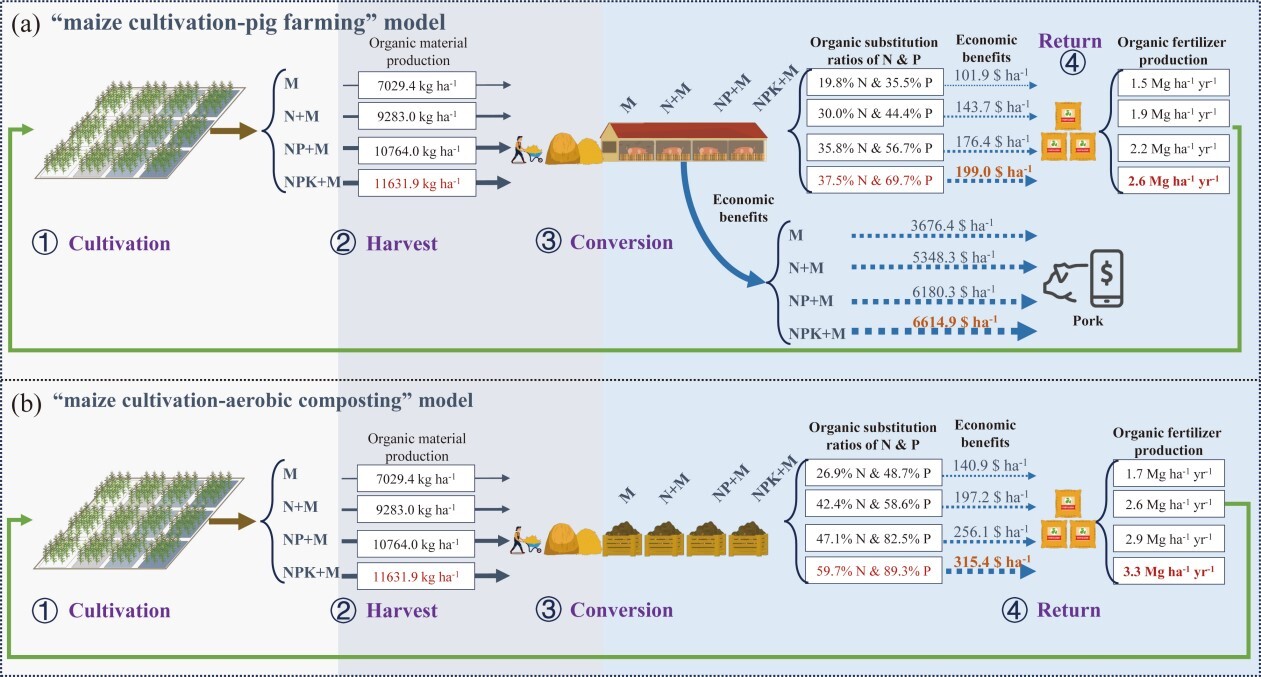
Figure 1. Differences in organic substitution potential and economic benefits between maize–pig farming and maize–aerobic composting systems under different fertilization regimes in Northeast China (Image by NING Yu).
