

RESEARCH NEWS
Researchers Reveal How Herbicide Residues Disrupt Soybean Soil Ecosystems and How a Herbicide-degrading Bacterium can Restore Nitrogen Cycling
Researchers from the Institute of Applied Ecology (IAE) of the Chinese Academy of Sciences have clarified how the herbicide chlorimuron-ethyl affects nitrogen cycling in soybean rhizosphere soils and demonstrated that a chlorimuron-ethyl-degrading bacterial strain, Chenggangzhangella methanolivorans CHL1, can help restore ecological stability in contaminated soils.
The study was published in the journal Geoderma.
The findings address concerns over the long-term accumulation of herbicide residues in agricultural soils. Herbicides that remain in soil after application may disrupt microbial communities and nutrient cycling processes that support crop growth. Nitrogen cycling, a series of biological processes that convert nitrogen between different forms available to plants and microorganisms, plays an important role in maintaining soil fertility and agricultural productivity. Microbial remediation, which uses microorganisms to break down pollutants, has become an important approach for managing contaminated farmland.
The research was conducted by the team of Xu Mingkai, a researcher at IAE’s Innovation Group on Environmental Pollution Processes and Effects. The team has long focused on the ecological effects of herbicides in agricultural systems and microbial mechanisms for pollutant remediation. In this study, the researchers evaluated the effects of chlorimuron-ethyl, a commonly used sulfonylurea herbicide in soybean fields, on soybean rhizosphere ecosystems through field experiments and controlled microcosm systems. They combined soil analyses with metagenomic approaches to assess changes in nitrogen cycling-related microorganisms and evaluate the contribution of CHL1 to soil recovery.
The researchers found that chlorimuron-ethyl exposure significantly inhibited soybean growth and root nodule formation, while altering soil nitrogen balance and reducing soil pH. Root nodules, which host nitrogen-fixing microorganisms that help plants obtain usable nitrogen, are essential for soybean nutrient acquisition. The herbicide also caused noticeable changes in rhizosphere microbial communities and nitrogen cycling processes.
The study showed that chlorimuron-ethyl reduced the abundance and functional contribution of microorganisms involved in nitrogen fixation and denitrification, while temporarily increasing the abundance of some microorganisms associated with nitrification. The abundance of key nitrogen fixation genes was strongly suppressed under herbicide exposure. These microbial changes were consistent with shifts in soil nitrogen forms, including reduced ammonium nitrogen and increased nitrate nitrogen.
Importantly, the researchers found that the CHL1 strain could rapidly degrade residual chlorimuron-ethyl in soil and reduce its ecological impacts. The bacterium shortened the herbicide’s persistence in soil by more than half and alleviated the inhibition of soybean growth and root nodule formation. It also helped restore nitrogen cycling-related microbial groups and functional genes, improving soil nitrogen conditions and helping normalize soil pH.
The researchers noted that the findings provide scientific support for the potential use of degrading bacteria in environmentally friendly soil remediation.
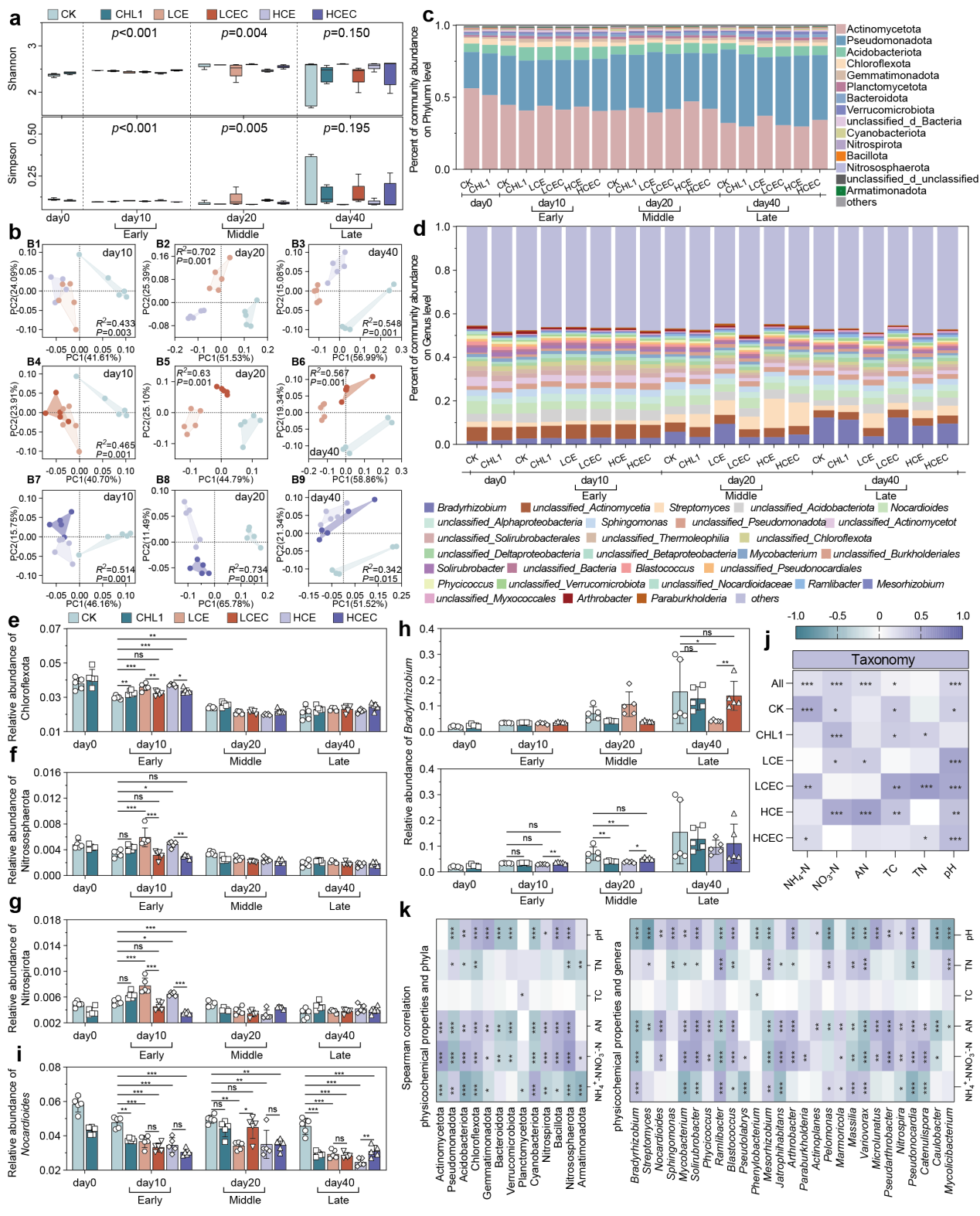
Figure 1. Changes in bacterial community composition and diversity in soybean rhizosphere soils and their associations with soil properties. The analysis includes bacterial alpha and beta diversity, microbial community composition at different taxonomic levels, changes in the abundance of key microbial groups, and correlations between soil properties and nitrogen cycling functions (Image by LI Xiang).
