

RESEARCH NEWS
Individual Plant Size and Plant Density Jointly Shape Grassland Responses to Extreme Drought
Declining individual plant size and plant density both contribute to grassland productivity losses under extreme drought, but their relative importance varies among plant functional groups and changes over time, according to a study by researchers at the Institute of Applied Ecology (IAE) of the Chinese Academy of Sciences (CAS).
The study was published in Global Change Biology.
Grasslands are particularly vulnerable to changes in precipitation, and climate projections indicate that droughts are likely to become more frequent and severe in many regions. Previous studies have documented that drought reduces aboveground net primary productivity (ANPP), the annual net rate at which plants accumulate aboveground biomass per unit area through photosynthesis, after accounting for respiratory losses. However, much of this research has focused on overall changes in plant community productivity, leaving the relative contributions of declining individual plant size and changes in plant density insufficiently understood. The distinction is important because these two pathways reflect different ecological processes, namely growth limitation versus mortality and recruitment failure, with the trade-off between them shaping how grassland productivity responds to drought.
To address this question, researchers including MA Wang, WANG Zhengwen, LÜ Xiaotao and LUO Wentao of IAE, together with Associate Professor Yann Hautier of Utrecht University, conducted two independent four-year extreme drought experiments at the Erguna Forest-Steppe Ecotone Ecosystem Research Station. The experiments simulated severe drought by intercepting 66% growing-season precipitation. By measuring plant density and individual plant size, the researchers distinguished plant density-mediated ANPP changes from individual size-mediated ANPP changes and assessed how each contributed to productivity losses.
The researchers found that drought-induced declines in grassland ANPP resulted from the combined effects of reduced plant density and smaller individual plants. However, the dominant mechanism differed between plant functional groups. For graminoids, which include grasses and grass-like plants, declines in ANPP were primarily associated with reductions in individual plant size. In contrast, declines in forb ANPP, involving broad-leaved herbaceous plants, were mainly driven by decreases in plant density.
The study also identified a trade-off between density-mediated and size-mediated changes in ANPP at both the functional-group and dominant-species levels. This trade-off was mediated by leaf functional traits, including leaf carbon and nitrogen content.
The relative importance of these processes also changed over time and varied with community structure. In experimental communities with higher plant diversity, productivity losses during the early stages of drought were mainly associated with restricted individual growth. As drought continued, plant mortality, limited recruitment and species loss became increasingly important, making declining density a more prominent driver of productivity losses. By comparison, communities with lower diversity and greater dominance by a few species experienced simultaneous declines in plant density and individual size during the first three years of drought.
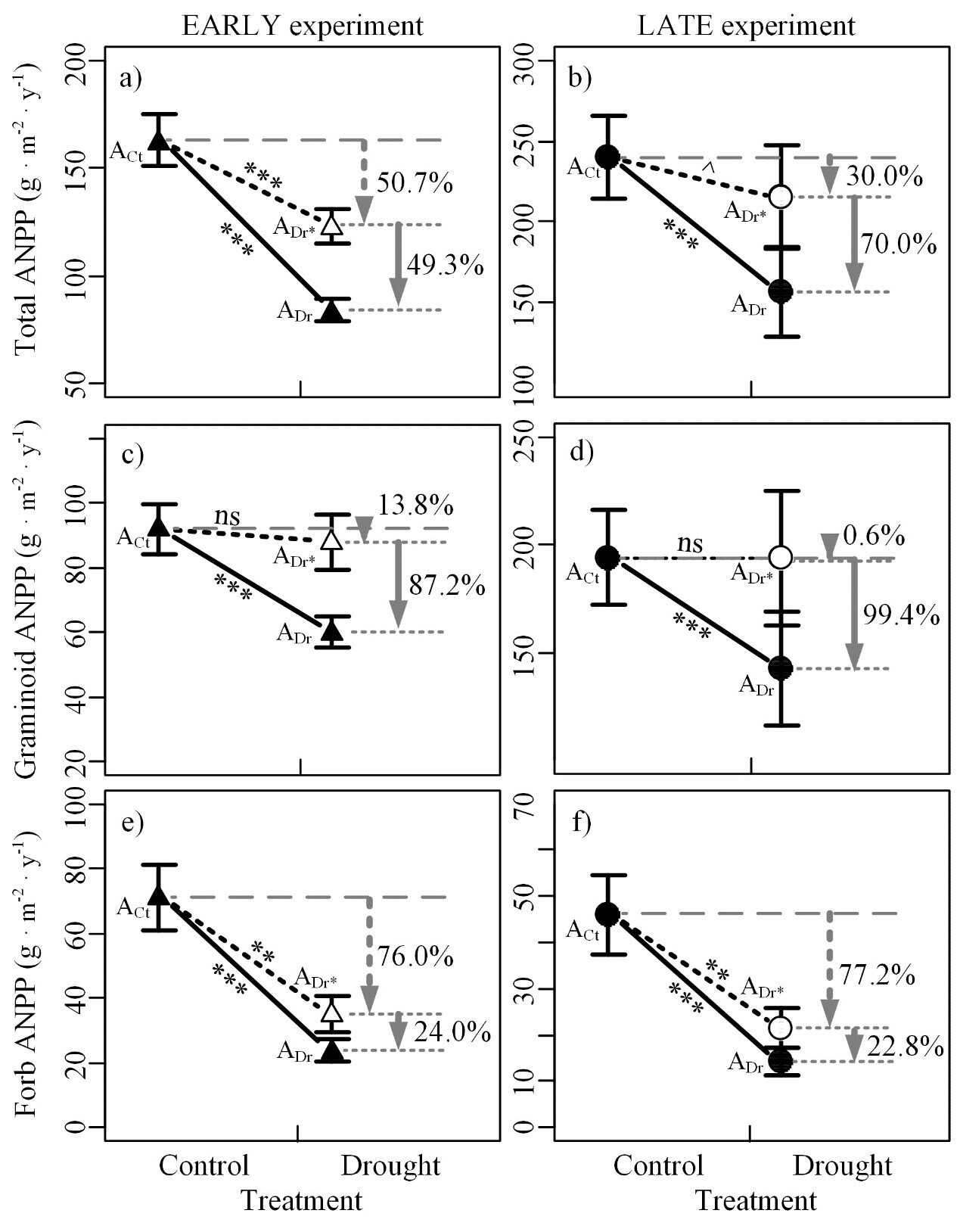
Figure 1. Contributions of individual plant size and plant density to drought-induced changes in aboveground net primary productivity (ANPP). Panels a and b show community-level responses, while panels c and d show responses of graminoids and panels e and f show responses of forbs (Image by MA Wang).
