


Researchers Leads National Synthesis on Forest Nitrogen Retention and Carbon Sequestration in China
A research team from the Institute of Applied Ecology, Chinese Academy of Sciences (CAS), has clarified how deposited nitrogen is retained in forest ecosystems and how this process contributes to carbon sequestration across China. The findings were published in the international journal Global Change Biology .
Despite experiencing some of the highest nitrogen deposition rates globally, the capacity of China’s forests to retain deposited nitrogen—and the extent to which this process enhances carbon sequestration—has remained poorly quantified due to the lack of a comprehensive, national-scale synthesis. This knowledge gap has limited accurate assessment of forest carbon–nitrogen cycling under global change.
To address this knowledge gap, the team, led by Prof. Yunting Fang and Dr. Geshere Abdisa Gurmesa from the CAS Key Laboratory of Forest Ecology and Silviculture, synthesized decades of ecosystem-scale 15N tracer experiments to provide the first national assessment of nitrogen retention and its carbon consequences in Chinese forests.
By integrating 15N tracer datasets from 18 forest sites spanning four biomes (boreal, temperate, subtropical, and tropical) and three successional stages (primary forests, secondary forests, and plantations), the study revealed three key findings. On average, Chinese forests retain ~65% of deposited nitrogen, with nearly two-thirds stored in soils. Retention shows strong spatial variation, reaching up to ~90% in boreal forests but declining to 50–70% in subtropical and tropical forests due to long-term nitrogen saturation.
The study further shows that forest successional stage and nitrogen form regulate nitrogen partitioning. Primary forests preferentially retain deposited nitrogen in mineral soils, whereas plantations retain more in soil organic layers. Nitrate is more efficiently taken up by plants, while ammonium is mainly retained in organic soil pools, reflecting differences in mobility and biological assimilation pathways.
Finally, the researchers quantified the contribution of nitrogen deposition to China’s forest carbon sink using stoichiometric upscaling approach. The carbon–nitrogen response ranges from 7 to 40 kg C per kg deposited N, with the strongest responses observed in boreal forests and young plantations. At the national scale, nitrogen deposition enhances forest carbon sequestration by approximately 0.11 Pg C yr⁻¹, accounting for 20–30% of China’s total forest carbon sink.
This study represents the first tracer-based, national synthesis of deposited nitrogen retention in Chinese forests, advancing understanding of carbon–nitrogen coupling and providing a scientific basis for forest management and climate change mitigation strategies.
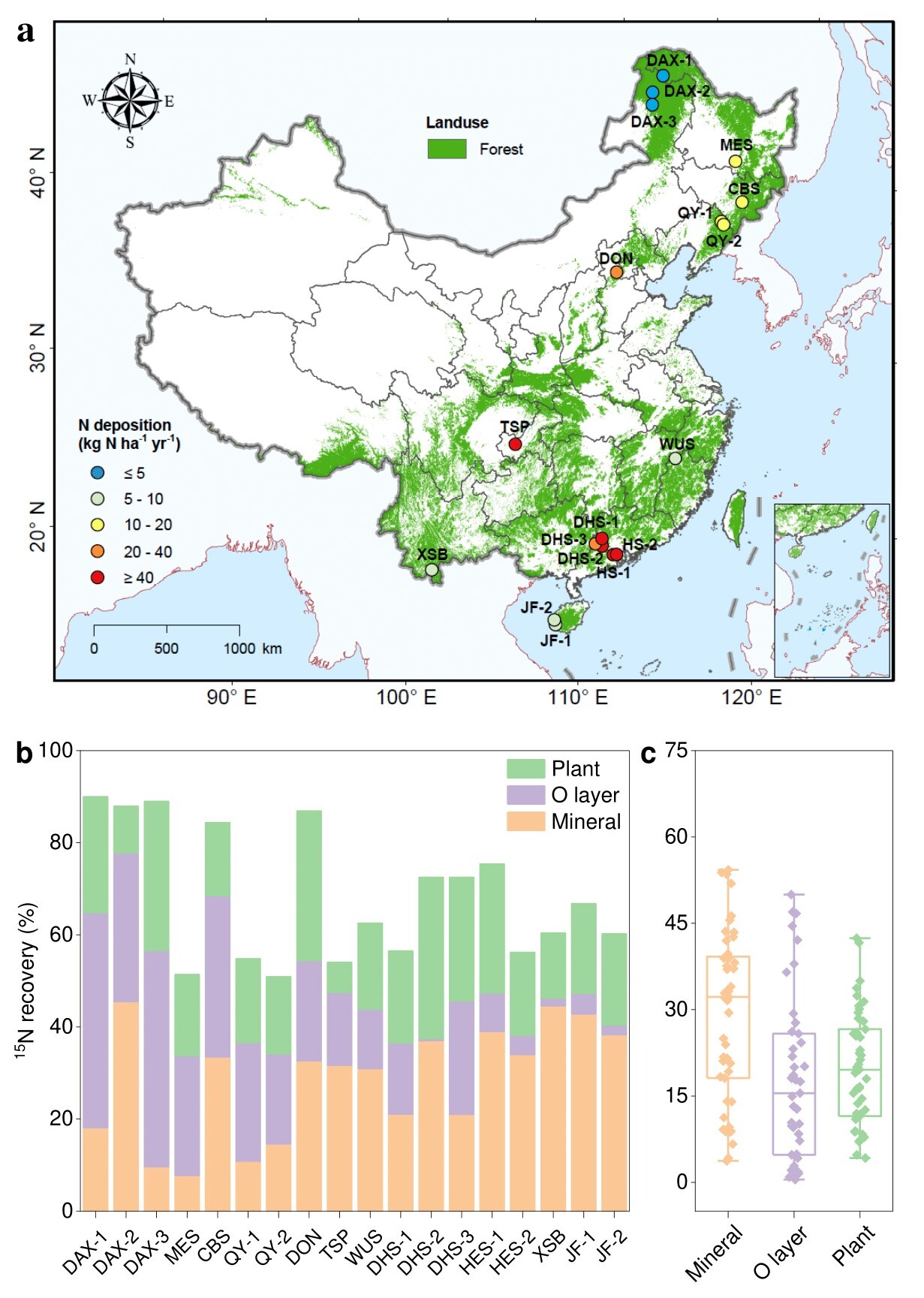
Figure 1. Distribution of 15N tracer sites (a) and variation in 15N recovery in plant and soil pools across Chinese forest biomes (b and c) indicating the efficiency of forests to retain deposited N (Image by Geshere Abdisa Gurmesa).
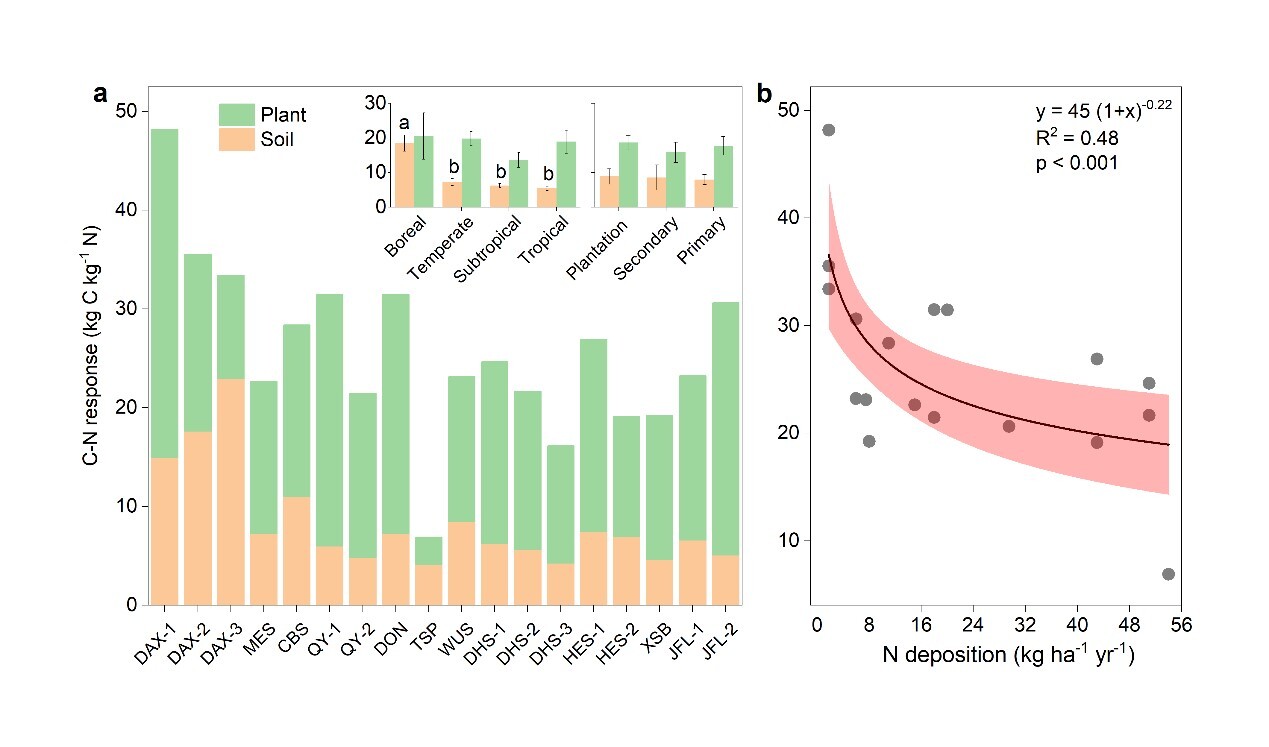
Figure 2. Nitrogen-induced forest carbon sequestration (C-N response) (a) and its decline with increasing nitrogen deposition (b) across Chinese forest ecosystems (Image by Geshere Abdisa Gurmesa).
