


Study Links Agricultural Management Intensity to Soil Priming Effect
A collaborative study led by researchers from the Institute of Applied Ecology, Chinese Academy of Sciences, has found that agricultural management intensity plays a key role in regulating the soil priming effect and, in turn, long-term soil carbon dynamics.
The study was published in Nature Communications.
The soil priming effect refers to changes in the rate at which native soil organic carbon is decomposed following the addition of fresh carbon inputs such as plant residues or organic materials like manure and compost. This process is considered an important component of the global carbon cycle because it influences whether soils act as carbon sources or sinks. Although the impacts of agricultural practices on soil organic carbon have been widely studied, less is known about how management intensity affects priming processes over long timescales and across broad geographic gradients.
To investigate this question, ZHANG Weidong’s team, with first author Dong Xiaohan and in collaboration with international partners including the Spanish National Research Council (CSIC), analyzed soils from eight long-term experimental sites spanning three major climate zones in Europe. These sites are part of the Long-Term Experiments network, which provides consistent observations of agricultural soils under different management regimes. The researchers classified soils into four levels of management intensity based on tillage practices and fertilization types, and applied a carbon-13 isotope tracing method to quantify the magnitude and direction of the priming effect under each condition. The isotope tracing approach allows scientists to distinguish between newly added carbon and pre-existing soil carbon, thereby enabling precise estimation of changes in carbon mineralization.
The researchers found that the priming effect is strongly associated with soil carbon content across European croplands. They reported that low-intensity management practices, such as organic fertilization and reduced or no tillage, significantly enhanced the priming effect. In these systems, values of the priming effect were substantially higher, at around 10 micrograms of carbon per gram of soil. In contrast, high-intensity practices, including exclusive use of chemical fertilizers and conventional tillage, reduced priming effect and in some cases led to negative priming effect, with much lower values, near 3 micrograms of carbon per gram of soil. A negative priming effect indicates a slowdown in the decomposition of existing soil carbon following fresh carbon input.
Further analysis showed that management intensity influenced the priming effect both directly and indirectly. Direct effects were associated with changes in soil organic carbon content, while indirect effects were linked to shifts in soil aggregate stability and soil microbial biomass. The researchers also identified several key predictors of priming dynamics, including the carbon-to-phosphorus ratio, total soil organic carbon, total nitrogen, and the activity of β-glucosidase, an enzyme involved in the breakdown of organic matter.
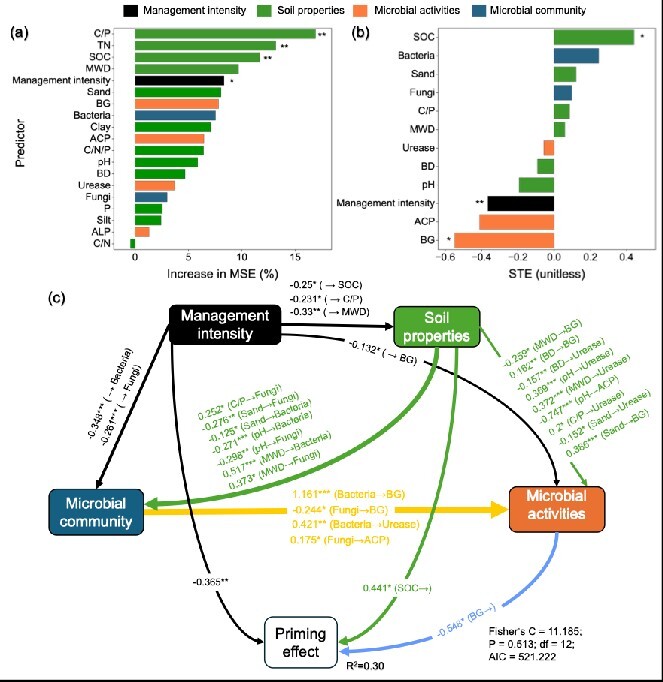
Figure 1. Modeling framework and spatial patterns of the soil priming effect across European agroecosystems (Image by ZHANG Weidong) .
