RESEARCH NEWS
Study Examines How Global Change Factors Alter Multi-Element Composition of Grassland Litter
Researchers at the Institute of Applied Ecology of the Chinese Academy of Sciences (CAS) have investigated how multiple global change factors influence the chemical composition of plant litter in temperate grasslands, finding that drought and nitrogen addition are the primary drivers of changes in litter multi-element characteristics, while variation within species plays a dominant role in shaping community-level responses.
The findings were published in Journal of Plant Ecology.
Plant litter, which consists of dead leaves and other plant materials that accumulate on the ground, serves as a critical link between aboveground vegetation and belowground ecological processes. Its chemical composition directly affects decomposition, nutrient release, and biogeochemical cycling in terrestrial ecosystems. Under ongoing global environmental change, grasslands are increasingly exposed to pressures such as extreme drought, rising nitrogen deposition, and shifts in snow dynamics. While previous studies have largely focused on carbon, nitrogen, phosphorus, and structural compounds such as cellulose and lignin, much less attention has been given to the responses of a broader range of essential mineral elements and the mechanisms driving these changes at the plant-community level.
To address these questions, a team led by Dr. WANG Zhengwen at the institute conducted a long-term multifactor global change experiment at the Erguna Forest-Steppe Ecotone Ecosystem Research Station in northern China. The researchers simulated nitrogen deposition through nitrogen addition, altered snow conditions through delayed snowmelt treatments, and imposed drought treatments both individually and in combination. They measured concentrations of primary macronutrients including carbon, nitrogen, phosphorus and potassium, secondary macronutrients calcium and magnesium, and micronutrients manganese, iron, copper and zinc in leaf litter. They also quantified the relative contributions of intraspecific trait variation and species turnover to community-level changes in litter elemental composition.
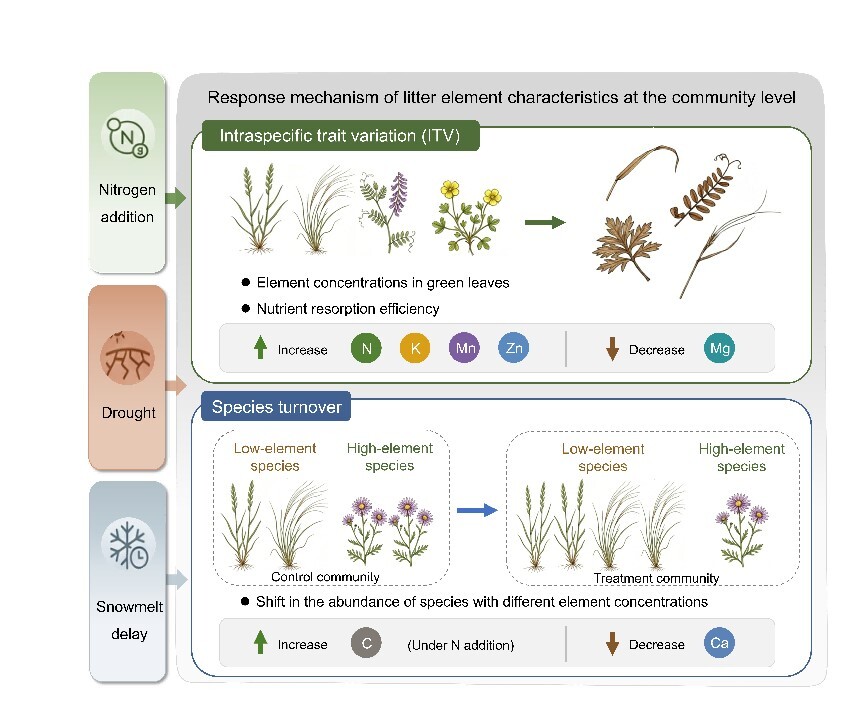
The researchers found that drought and nitrogen addition had much stronger effects on litter elemental composition than delayed snowmelt. Overall, concentrations of carbon, nitrogen and potassium in litter increased in response to drought or nitrogen addition. In contrast, calcium and magnesium concentrations declined under nitrogen addition, although drought partially weakened this effect. Among the micronutrients examined, manganese and zinc showed positive responses to nitrogen addition and drought, respectively, while copper and iron remained largely unchanged.
Further analyses showed that intraspecific trait variation, which refers to changes in traits within the same species under different environmental conditions, was the dominant mechanism driving community-level changes in litter chemistry. In most cases where significant responses occurred, it accounted for the majority of observed variation. The researchers found that this mechanism was particularly important in explaining increases in nitrogen, potassium, manganese and zinc concentrations, as well as declines in magnesium concentration.
Species turnover, which reflects shifts in the relative abundance or presence of different plant species within a community, played a more limited but sometimes critical role. The researchers found that it was the primary mechanism responsible for declines in litter calcium concentration across treatment conditions. They also observed that species turnover could offset the positive effect of intraspecific trait variation on manganese concentration, helping maintain relatively stable community-level manganese levels despite environmental change.
According to the researchers, the study demonstrates that different litter elements respond in distinct ways to multiple global change drivers and that these responses are governed by the combined influences of trait variation within species and changes in species composition.