

RESEARCH NEWS
Seven-Year Field Experiment Identifies Threshold Response of Grassland Arthropod Communities to Phosphorus Enrichment
Researchers from Institute of Applied Ecology, Chinese Academy of Sciences (CAS) have found that phosphorus enrichment can trigger threshold-like, nonlinear shifts in grassland arthropod community composition that mirror the changes in plant phosphorus content, even when overall arthropod abundance and diversity remain largely unchanged.
Phosphorus is an essential nutrient that supports the structure and functioning of terrestrial ecosystems. Changes in phosphorus availability can reshape food-web interactions and plant nutrient balance, influencing community assembly across multiple trophic levels. While the ecological consequences of nitrogen deposition in grasslands have been extensively studied, much less is known about how phosphorus inputs influence arthropod communities, particularly with respect to the responses of different functional groups.
The study found that phosphorus addition did not significantly change the overall abundance or diversity of arthropod communities, but it substantially altered community composition, especially at phosphorus-addition levels from 4 to 10 g P m-2 yr-1. Arthropod community composition showed a nonlinear response to phosphorus addition, with compositional shifts becoming more pronounced up to a threshold near 4 g P m-2 yr-1, after which they tended to stabilize, closely matching changes in plant phosphorus content (Figure 1). Further analysis showed that the shift in arthropod community composition was mainly driven by herbivorous and detritivorous groups, both of which were strongly associated with phosphorus content in plants and litter, highlighting the link between plant stoichiometry and arthropod community structure. These findings indicate that changes in plant phosphorus content is an important factor regulating grassland arthropod community composition under phosphorus addition.
The findings were published in Agriculture, Ecosystems & Environment with the title "Non-linear response of arthropod community composition to plant stoichiometry under phosphorus addition."
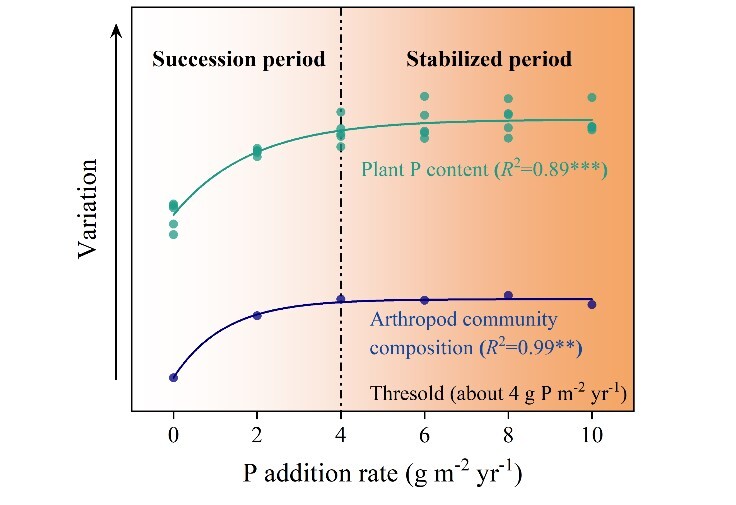
Figure 1. Non-linear responses of plant phosphorus content and arthropod community composition along the gradient of phosphorus addition rates (Image by ZHANG Bingchuan).
