RESEARCH NEWS
Forest Biodiversity Study Recognized Among China’s Top Ecological Science Advances in 2025
A study led by Senior Researcher WANG Xugao and his team at the Institute of Applied Ecology, Chinese Academy of Sciences, has been selected as one of the “Top 10 S&T Advances in Eco-Environmental Protection of China 2025.”
The honored study, titled “A Novel Spatial Mechanism underlying the maintenance of Forest Biodiversity,” was completed solely by the institute and was selected through a rigorous national evaluation process organized by the Eco-Environmental Industry-Academia Alliance of the China Association for Science and Technology. The annual list, now in its seventh consecutive year, has become a key benchmark for tracking frontier developments in China’s ecological and environmental research, with recommendations from academicians, universities, and research institutions followed by multiple rounds of expert review and final approval by leading scientific panels.
Focusing on one of ecology’s central questions—how forest ecosystems sustain high levels of biodiversity over long time scales—the research draws on data from a 25-hectare temperate forest plot established in Changbai Mountain, the world’s first of its kind in a temperate zone. The team discovered that more than 80 percent of forest plant species exhibit clustered spatial distributions, a pattern that had been substantially underestimated in earlier studies based on small sample plots, which could only detect about 30 percent of such aggregation.
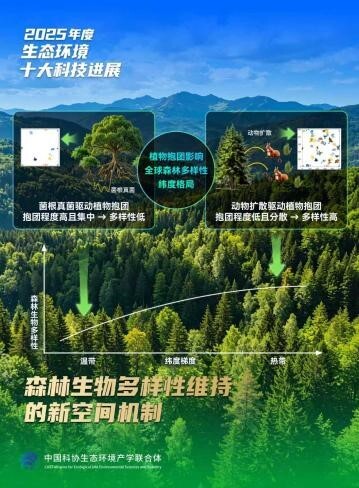
By developing a multilevel spatial modeling framework linking individuals, species, and communities, the researchers improved the accuracy of long-term forest biodiversity predictions by 52 percent. The model was further validated across 21 large forest plots spanning tropical, subtropical, and temperate regions worldwide, leading to a novel explanation for a long-standing ecological pattern: the global latitudinal gradient in plant diversity, characterized by higher diversity in the tropics and lower diversity in temperate zones, may be partially explained by differences in species aggregation patterns.
The study also revealed fundamentally different drivers behind the formation of clustered plant distributions in different latitudinal zones. In tropical forests, seed dispersal by animals such as birds and squirrels plays a dominant role, while in temperate forests, underground symbiotic relationships involving mycorrhizal fungi are the key regulating factor shaping spatial aggregation.
The researchers noted that these findings carry important implications for global forest conservation and management strategies. In tropical regions, priority should be given to protecting seed-dispersing animals, whereas in temperate ecosystems greater attention should be directed toward soil microbial communities such as mycorrhizal fungi. The study further suggests that forest management practices should emphasize the conservation of patch-like habitats and the intentional creation of clustered, same-species spatial structures, which may enhance the stability of tree coexistence and improve the overall effectiveness of afforestation efforts.
The results of the study have been published in leading international journals including Nature and Fundamental Research.