

RESEARCH NEWS
A Four-Decade Record Reveals Asymmetric Seasonal Shifts in Vegetation Growth Across China's Forest-Grassland Ecotone
Global warming is reshaping terrestrial vegetation, but its effects are often uneven across the growing season, especially in ecologically sensitive transition zones. A new study by researchers from the Institute of Applied Ecology of the Chinese Academy of Sciences has found that vegetation in China's forest-grassland ecotone responds to climate change in markedly different ways from spring to autumn, highlighting the region's value as an early indicator of broader ecological change.
The study was published in the journal Ecological Indicators.
The forest-grassland ecotone is a transitional landscape where forests and grasslands intermingle, forming a complex mosaic. The Chinese section covers approximately 1.01 million km², accounting for nearly half of the Eurasian forest-grassland ecotone and stretching southwestward from eastern Inner Mongolia to the southeastern Tibetan Plateau. This ecotone plays an important role in regional carbon storage, water cycling, and climate regulation. Its vegetation is highly responsive to climatic fluctuations—even minor shifts can trigger noticeable changes in growth.
Using four decades (1982-2022) of PKU GIMMS NDVI and the China Meteorological Forcing Dataset (CMFD), the study—led by Researcher WANG Zhengwen, Associate Researcher LI Yuehui and Dr. GUO Jia—tracked monthly trends in vegetation greenness and growth rate during the growing season (April-November) across the climatically sensitive Chinese forest-grassland ecotone. Here, vegetation greenness, quantified by the NDVI, reflects the structural state of the vegetation. The vegetation growth rate, by contrast, is represented by VNDVI (the month-to-month difference in NDVI) and thus more directly captures dynamic physiological processes, such as photosynthetic carbon assimilation and allocation. Distinguishing between an ecological state and a process rate in this way is essential for revealing how climate drivers mechanistically regulate vegetation growth.
The researchers found widespread greening across the region over the four decades, with NDVI increasing significantly in all growing-season months except November. However, VNDVI showed a marked asymmetric seasonal pattern. During the early growing season, vegetation development accelerated significantly in April and May but decelerated in August. During the senescence stage, the rate of senescence decreased significantly in October but increased markedly in November.
Temperature emerged as the dominant climatic driver, influencing vegetation greenness across more than half of the study area and exerting the strongest control over growth rates across roughly 40% of the region. Crucially, its effect reversed as the growing season progressed. Warmer conditions promoted vegetation growth in cool spring, but suppressed it in summer as heat intensified water stress. This seasonal shift—from strongly positive correlations in April and May to negative correlations from June to August—reflects a transition from energy-limited to water-limited growth, as rising summer temperatures intensify evaporative demand and soil moisture depletion, ultimately constraining further growth.
The study also revealed that both NDVI and VNDVI trends in the Chinese forest-grassland ecotone were substantially stronger than those previously reported for temperate China and the middle-to-high latitudes of the Northern Hemisphere. According to the researchers, this heightened sensitivity means the ecotone could serve as an early-warning sentinel—a region where vegetation responses to ongoing climate change manifest sooner and more prominently than in surrounding landscapes.
By capturing monthly rather than annual vegetation dynamics, the study uncovered seasonal changes often masked by coarser time scales. The researchers emphasized that continued warming makes sustained monitoring of ecotones increasingly urgent. Early detection of vegetation shifts in these sentinel landscapes can deepen our understanding of terrestrial ecosystem responses to climate change and provide critical lead time for adaptation.
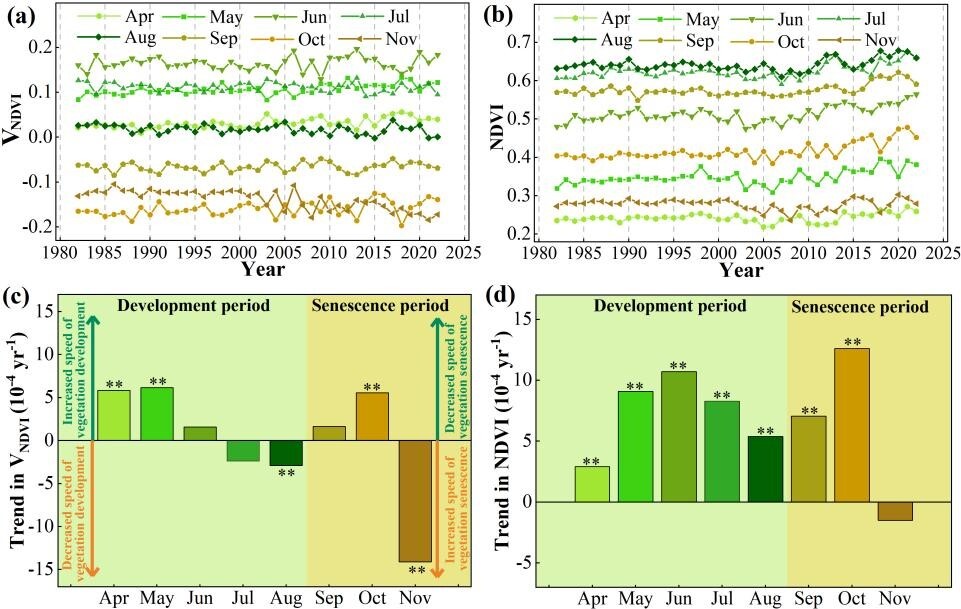
Figure 1. Temporal trends in monthly VNDVI (a) and NDVI (b), their corresponding trend values (c, d) during the growing season (April-November) in the Chinese forest-grassland ecotone from 1982 to 2022. Two asterisks indicate a statistically significant trend (p < 0.05) (Image by GUO Jia).
