

RESEARCH NEWS
Sulfur Addition Enhances Microbial Carbon Use Efficiency by Promoting K-Strategy Dominance in a Meadow Steppe
Researchers at the Institute of Applied Ecology, Chinese Academy of Sciences (CAS), have found that long-term sulfur deposition can significantly alter microbial carbon use efficiency (CUE), a key physiological parameter that determines the direction of soil carbon cycling.
The study was published in Plant and Soil.
Soil microbial CUE describes how effectively microorganisms convert assimilated carbon into biomass rather than respiring it as carbon dioxide. It is widely regarded as a central parameter for predicting soil carbon dynamics and is influenced by vegetation, the availability and chemical composition of soil carbon, nutrient balance, and microbial community structure. Atmospheric sulfur deposition, largely driven by industrial emissions, has been recognized as an environmental stressor that alters ecosystem structure, particularly in grasslands. However, it effects on microbial CUE through plant–soil–microbe interactions have remained poorly understood.
The work was led by Dr. Lu Changming, with researcher Li Hui and assistant researcher Wang Zhirui serving as co-corresponding authors. The team used a field experiment established in 2017 at the Erguna Forest-Steppe Ecotone Research Station, where different levels of sulfur were added to a meadow grassland ecosystem.
The researchers found that sulfur addition significantly reduced microbial CUE, and this decline was primarily driven by a shift in the microbial community toward K-selected life-history strategies. This ecological strategy describes organisms adapted to resource-limited environments, characterized by slower growth and more conservative resource use. This shift was evidenced by a decreased ratio of copiotrophic to oligotrophic bacteria, reduced bacterial 16S rRNA operon copy numbers at the community level, and a lower ratio of β-glucosidase to cellulase activity.
The transition toward K-selected microbial communities was mainly attributed to two pathways. First, sulfur addition-induced soil acidification reduced the soil nitrate-to-ammonium ratio. Second, acidification changed plant community composition by increasing the biomass ratio of grasses to forbs, which led to lower litter quality and subsequently reduced soil carbon lability. Together, these changes created more resource-limited conditions that favored K-selected microbial communities.
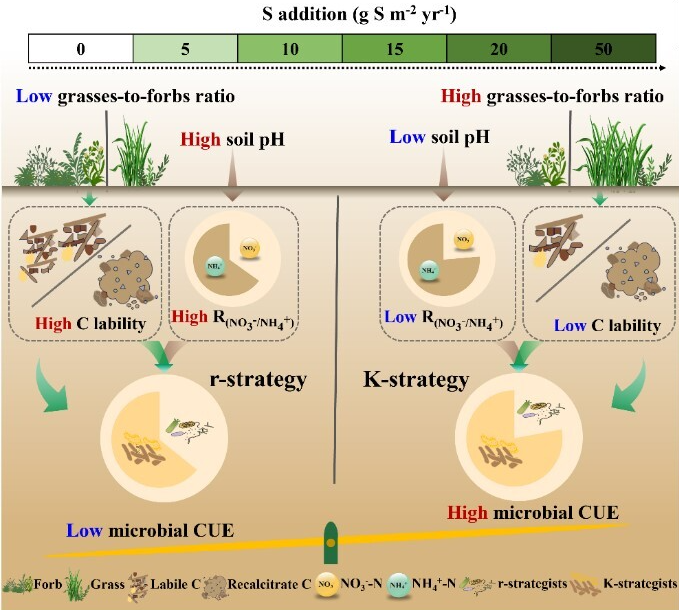
Figure 1. Conceptual model of S addition effects on microbial CUE through changing resource availability and microbial ecological strategies (Image by Lu Changming).
