

RESEARCH NEWS
Mycorrhizal Composition and Species Dominance Affect Forest Plant Diversity Across Northeastern China
Researchers from the Institute of Applied Ecology (IAE) of the Chinese Academy of Sciences (CAS) have found that mycorrhizal composition and species dominance jointly shape patterns of forest plant species richness and abundance.
The study was published in Communications Earth & Environment.
Understanding how environmental conditions and biotic interactions together regulate plant species richness and abundance is a fundamental question in ecology. Climate and topography act as environmental filters that determine species distributions, while interactions among organisms, including symbiosis with fungi and competition between plants, further shape local communities. Many forest plants form symbiotic relationships with either arbuscular mycorrhizal (AM) fungi or ectomycorrhizal (EcM) fungi. These two mycorrhizal strategies differ in nutrient acquisition and may affect plant coexistence through resource use, plant-soil interactions and competition. However, how mycorrhizal composition and species dominance jointly regulate different vegetation layers, including trees, shrubs and herbs, remains insufficiently understood.
Researchers including LIU Bo, LIANG Yu, WANG Xugao, SUN Tao and YANG Jian of IAE, CAS, together with collaborators, conducted vegetation surveys from 1,917 plots across 38 nature reserves in northeastern China. The researchers combined field observations of different vegetation layers with environmental information to identify the pathways linking climatic and topographic gradients, mycorrhizal strategies and plant community structure.
The researchers found that tree species richness peaked at intermediate levels of AM and EcM dominance, supporting the “mycorrhizal mixture hypothesis,” which suggests that coexistence of different mycorrhizal strategies may promote plant diversity. In contrast, higher species dominance generally reduced species richness across tree, shrub and herb layers, while increasing community abundance.
The study also showed that the mycorrhizal composition of canopy trees can influence plants growing beneath them. Forests with AM-dominated canopies were generally associated with higher understory (plants growing beneath the forest canopy) species richness but lower abundance compared with EcM-dominated canopies. These cross-layer effects were especially evident in shrub communities.
The researchers further found that climatic and geographical differences across northeastern China influenced forest communities indirectly by altering mycorrhizal composition and species dominance. Warmer and wetter temperate forests were more frequently associated with AM-dominated communities and higher plant richness, while colder and drier boreal forests were more associated with EcM dominance and lower species richness.
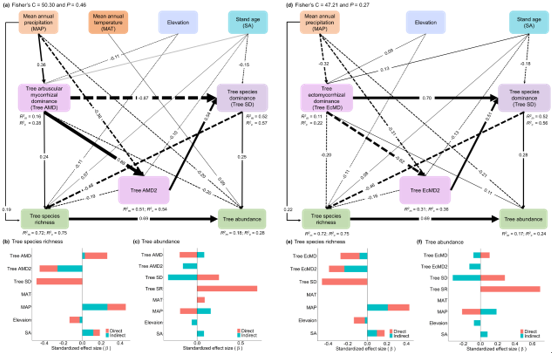
Figure 1. Pathways linking environmental factors, mycorrhizal composition and species dominance to tree-layer species richness and abundance (Image by LIU Bo)
