

RESEARCH NEWS
Forest recovery after disturbance drives China’s forest carbon sink, study finds
Forest recovery on land affected by fires, harvest and other disturbances has been the main contributor to China’s forest carbon sink over the past three decades, according to a study by researchers from the Institute of Applied Ecology (IAE) of the Chinese Academy of Sciences (CAS) and their domestic and international collaborators.
The study was published in Nature Geoscience.
A carbon sink is an ecosystem that absorbs more carbon from the atmosphere than it releases over a given period. Forests are a major component of the global terrestrial carbon sink, with their net carbon sink determined by the balance between carbon uptake as trees grow and carbon emissions caused by processes including biomass burning from fires and fuelwood, and the decomposition of coarse woody debris and harvest wood product following fire and harvest.
China’s forest carbon sink has generally increased over recent decades as forest area and biomass have expanded. However, estimates have differed substantially, and the relative contributions of forest recovery after disturbances, new forest establishment, and disturbance-induced carbon emissions have remained insufficiently quantified.
Using high-resolution data on forest disturbances and biomass, researchers including XU Wenru, LIU Zhihua and ZHU Jiaojun of IAE, together with collaborators from several institutions in China and abroad, built a spatially explicit forest carbon accounting model that tracked annual carbon uptake and emissions across China at a 30-meter spatial resolution from 1986 to 2019.
The researchers found that forests recovering after disturbance accumulated carbon at a higher rate than newly established forests, making reforestation the dominant contributor to China’s forest carbon sink over the past three decades.
In the study, reforestation refers to forest recovery on land that had previously been forested but was affected by disturbances such as fire or harvest, while afforestation refers to establishing forests on land that was not previously forested.
The findings help distinguish the contributions of reforestation and afforestation to China’s forest carbon sink.
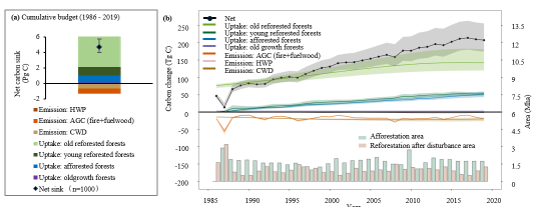
Figure 1. Carbon accumulation in forests recovering after disturbance and newly established forests on non-forest land, and carbon losses caused by forest disturbances in China, 1986–2019 (Image by XU Wenru).
