

RESEARCH NEWS
Researchers Review Isotope Methods for Tracing and Quantifying Soil Gaseous Nitrogen Losses
Researchers from the Institute of Applied Ecology (IAE) of the Chinese Academy of Sciences (CAS) have reviewed advances in stable nitrogen isotope techniques for tracing the sources and quantifying the production of gaseous nitrogen in soils, highlighting methodological innovations that have improved understanding of the microbial processes responsible for emissions of nitrous oxide (N2O), nitric oxide (NO), and dinitrogen (N₂).
The review, entitled “Soil gaseous nitrogen losses: Development and applications of nitrogen isotope approaches in China”, was published online in Soil Ecology Letters on October 9, 2026.
Gaseous nitrogen losses represent an important pathway of nitrogen removal from terrestrial ecosystems, influencing ecosystem nitrogen balances, climate change and air quality. Soil microorganisms produce and transform nitrogen-containing gases through processes such as nitrification, denitrification and anaerobic ammonium oxidation (anammox). These processes frequently occur simultaneously and interact under changing environmental conditions, making it difficult to determine the contribution of individual pathways. Stable nitrogen isotope techniques, particularly nitrogen-15 (¹⁵N) tracing and natural-abundance N2O isotopocule analysis, offer ways to identify nitrogen sources and quantify the contributions of different microbial pathways.
The team, including first author WEI Huanhuan and corresponding author FANG Yunting, reviewed four major approaches to isotope-based source partitioning. The review outlines their scientific principles, experimental designs, calculation methods, advantages and limitations, and discusses their applications across forest and agricultural ecosystems.
One approach, known as the three-pool source partitioning method, distinguishes the contributions of three major soil nitrogen pools, namely ammonium, nitrate and organic nitrogen, to N₂O production. Another, the combined 15N paired-labeling and isotope-pairing technique (Paired ¹⁵N-IPT), uses separate 15NH4+ and 15NO3--labeling treatments under anaerobic conditions or in the presence of nitrification inhibitors to quantify N₂ production rates and distinguish the relative contributions of denitrification, anaerobic ammonium oxidation (anammox) and codenitrification to N₂ production. The isotope-pairing approach relies on measurements of 28N2, 29N2, and 30N2, together with random isotope-pairing relationships and mass balance, allowing researchers to distinguish the contributions of different microbial pathways to N₂ production.
The researchers also describe a method that combines ¹⁵NO₃⁻ labeling and isotope pairing with nitrification inhibitors (NI-coupled ¹⁵NO₃⁻-IPT). In the inhibitor-treated incubation, N₂O isotopologue measurements are combined with isotope-pairing calculations and mass balance to estimate the contributions of denitrification, codenitrification, and heterotrophic nitrification. The contribution of autotrophic nitrification is then estimated from the difference in total N₂O production between parallel 15NO3--labeled treatments with and without the inhibitor. It uses a single 15NO3- isotope tracer, reducing experimental complexity compared with paired 15N labeling or 15N-18O dual-isotope labeling approaches. In extended anaerobic incubation designs, it can also help distinguish the pathways responsible for NO and N₂ production.
The fourth approach uses the site preference (SP) of N₂O isotopocules, defined as the difference in δ¹⁵N values between the central (α) and terminal (β) nitrogen positions in an N₂O molecule (SP = δ15Nα – δ15Nβ). Because different microbial production pathways generate characteristic isotopic patterns, these differences can help researchers identify the processes responsible for N₂O emissions. Unlike tracer-based methods, this approach does not require the addition of labeled nitrogen, reducing disturbance to the soil system and making it suitable for both laboratory experiments and field studies. When SP and other N2O isotopic signatures are analyzed using the isotopocule mapping approach or the Fractionation And Mixing Evaluation (FRAME) model, they can help estimate the relative contributions of different production pathways and the fraction of N₂O remaining after partial microbial reduction to N₂.
The review highlights the contributions of Chinese researchers to the development and refinement of these methods over the past two decades, including improvements in experimental design, isotope-labeling strategies, analytical instrumentation and source-partitioning models. In particular, the stable isotope ecology research group at IAE developed the Paired ¹⁵N-IPT and NI-coupled ¹⁵NO₃⁻-IPT approaches by building on established ¹⁵N-tracing and isotope-pairing techniques. These methods have expanded researchers' ability to distinguish microbial pathways and quantify their respective contributions to gaseous nitrogen production.
Looking ahead, the researchers emphasize the need to extend isotope-based investigations beyond laboratory incubations to field-based experiments and in situ isotope labeling. They also call for improvements in the sensitivity and stability of analytical instruments, greater standardization of measurement procedures, and closer integration of isotope techniques, analytical systems and mathematical models. Such developments could improve how soil nitrogen transformation processes are represented in ecosystem models and provide a stronger scientific basis for developing targeted strategies to mitigate gaseous nitrogen losses.
The work was supported by the National Key Research and Development Program of China and the National Natural Science Foundation of China.
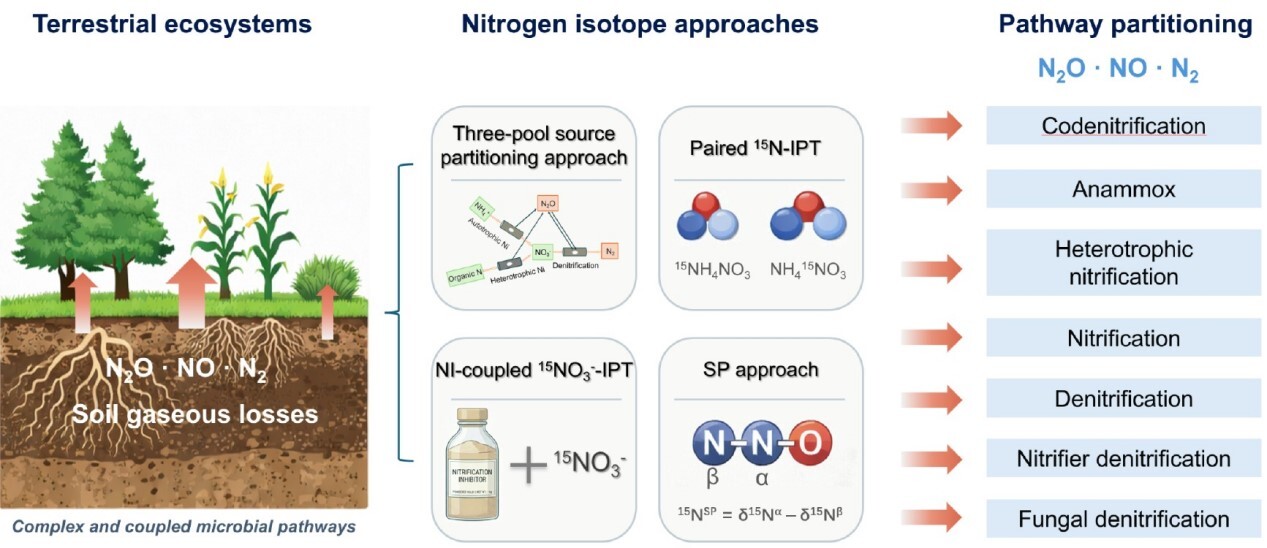
Figure 1. Four major nitrogen isotope approaches and their applications in research on soil gaseous nitrogen losses (Image by WEI Huanhuan).
