


Scientists Uncover How Microbial Consortia Break Down Lignin
A research team from the Institute of Applied Ecology (IAE) of the Chinese Academy of Sciences has provided new insight into how microbial communities work together to break down lignin.
The findings were published in the journal Frontiers in Microbiology.
Lignin is a tough, woody compound that makes up plant cell walls and is one of the world’s most abundant renewable sources of aromatic carbon. Commonly found in crop residues such as straw, lignin has long posed challenges to efficient decomposition and utilization due to its highly complex structure. The difficulty of breaking down this natural polymer limits its conversion into high-value products such as biofuels and bioplastics. Biological degradation, however, offers an environmentally friendly alternative to conventional chemical and thermal methods. By relying on the coordinated activity of microorganisms, this approach can decompose lignin under mild conditions with lower carbon emissions.
Dr. XU Mingkai’s research team addressed this long-standing challenge by developing a “top-down” synthetic microbiome strategy to enrich microbial consortia capable of efficient lignin degradation from straw compost and straw-returning soils.
The researchers investigated the community composition, gene functions, and metabolic interactions of the consortia through a combination of high-throughput sequencing, metagenomic analyses, and metabolomic analyses. They found that Pseudomonas was the dominant genus in all three consortia. Among them, the consortium labeled R0 exhibited the highest degradation efficiency, successfully breaking down more than 80 percent of alkali lignin within six days. Further analysis showed that R0 contained an abundance of genes from the Auxiliary Activities (AA) family, which encode carbohydrate-active enzymes involved in lignin degradation.
The team also identified two major metabolic pathways, the aminobenzoate and benzoate pathways, which play key roles in converting lignin into smaller, usable molecules. During this degradation process, protocatechuic acid was detected as a crucial intermediate compound.
According to the researchers, the findings show that microbial consortia can form more complete degradation pathways than single strains through synergistic metabolism and functional complementarity, leading to higher degradation efficiency. The study provides theoretical guidance for developing lignin biodegradation technologies for industrial applications.
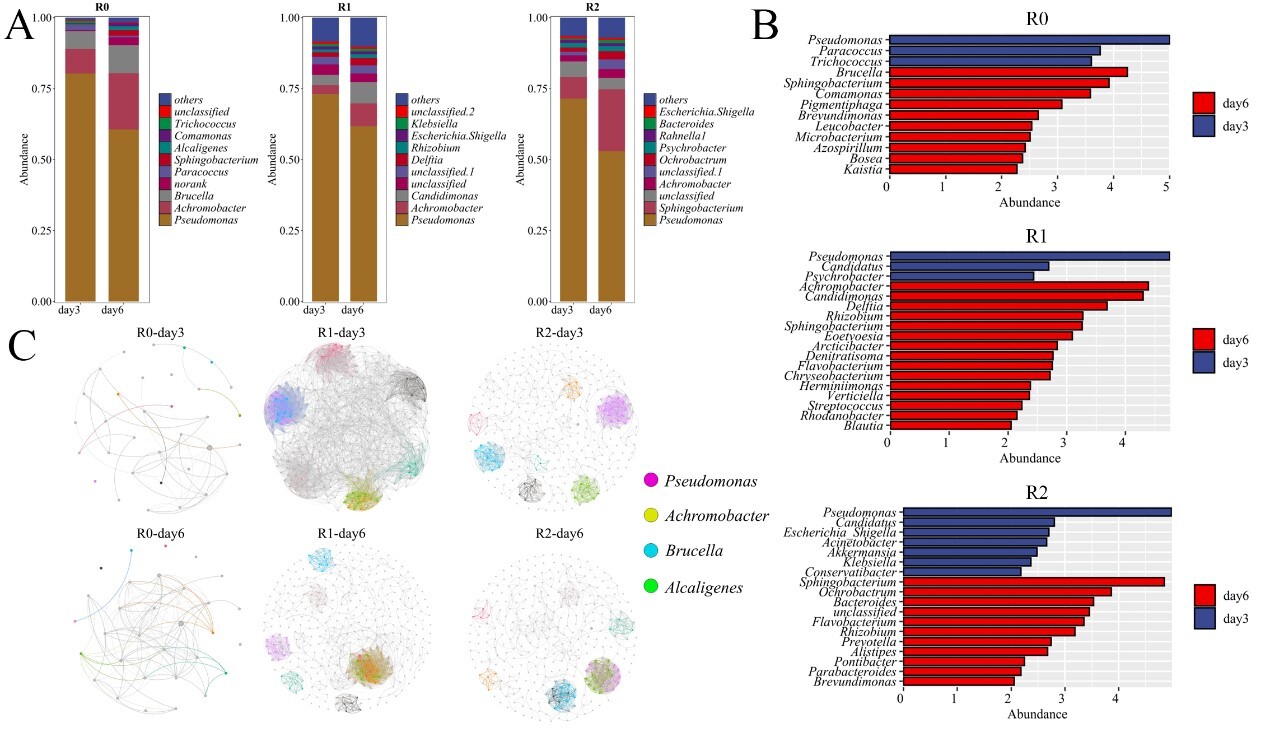
Figure 1. Analysis of the three lignin-degrading microbial consortia based on 16S rRNA sequencing. (A) Species abundance. (B) Effect Size analysis of microbial communities. (C) Network visualization of microbial interactions within the consortia (Image by RU Jinchuang and JIANG Zhiyang).
