


Framework Proposed for Assessing Nitrogen Conditions in Forest Ecosystems Under Global Environmental Change
Researchers from the Institute of Applied Ecology (IAE) of the Chinese Academy of Sciences have proposed a structured framework for evaluating the nitrogen (N) status and nitrogen balance of forest ecosystems in the context of rapid global environmental change.
The results were published in Environmental Reviews.
Nitrogen status describes whether an ecosystem experiences nitrogen limitation or nitrogen saturation, a condition in which nitrogen inputs exceed biological demand. This balance affects forest productivity, biodiversity, and the global carbon cycle. Although many indicators are currently used to assess nitrogen conditions, their comparability and clarity remain unclear, making it difficult to diagnose forest nitrogen status consistently across regions and forest types.
Drs. FANG Yunting and Geshere A. Gurmesa collaborated with researchers from multiple countries to assess 16 commonly used and emerging indicators. These indicators were grouped into soil-related (soil carbon-to-nitrogen ratios, inorganic nitrogen concentrations, nitrogen transformation rates, and soil δ15N), tree-related (including foliar nitrogen content, nutrient ratios such as N:P, and natural 15N abundance in leaves and tree rings), and ecosystem-related indicators (litterfall nitrogen flux, nitrate leaching, and nitrous oxide emissions).
The researchers found that many classical indicators, such as foliar nitrogen concentration and soil C:N ratios, remain effective for detecting shifts in nitrogen availability. Emerging isotope-based measures, including δ15N values in foliage, soil, and tree rings, offer additional advantages because they integrate long-term nitrogen cycling information and help distinguish between nitrogen limitation and gradual nitrogen enrichment. δ15N is a measure of the ratio of heavy nitrogen (15N) to light nitrogen (14N) in organic matter and is widely used in ecology to trace nutrient transfer and identify changes in nitrogen cycling processes.
Despite these strengths, the study emphasized that most indicators still lack universally applicable threshold values that are needed to distinguish reliably between nitrogen limitation, transitional states, and nitrogen saturation. No single metric can fully describe the overall nitrogen balance of a forest ecosystem, as each typically represents only a specific process in the nitrogen cycle. The researchers therefore highlight the need to combine complementary indicators to generate more comprehensive and accurate assessments.
The team also reported that only a few indicators, such as foliar nitrogen concentration and N:P ratio, exhibit measurable relationships with forest health parameters, including crown defoliation and nutrient imbalances. They recommend that future research focus on establishing threshold systems tailored to specific forest types and regions, developing integrated multi-indicator evaluation frameworks, and clarifying mechanistic links between nitrogen indicators, forest health, and ecosystem functioning. Such advances, they note, will support adaptive forest management strategies under accelerating global environmental change.
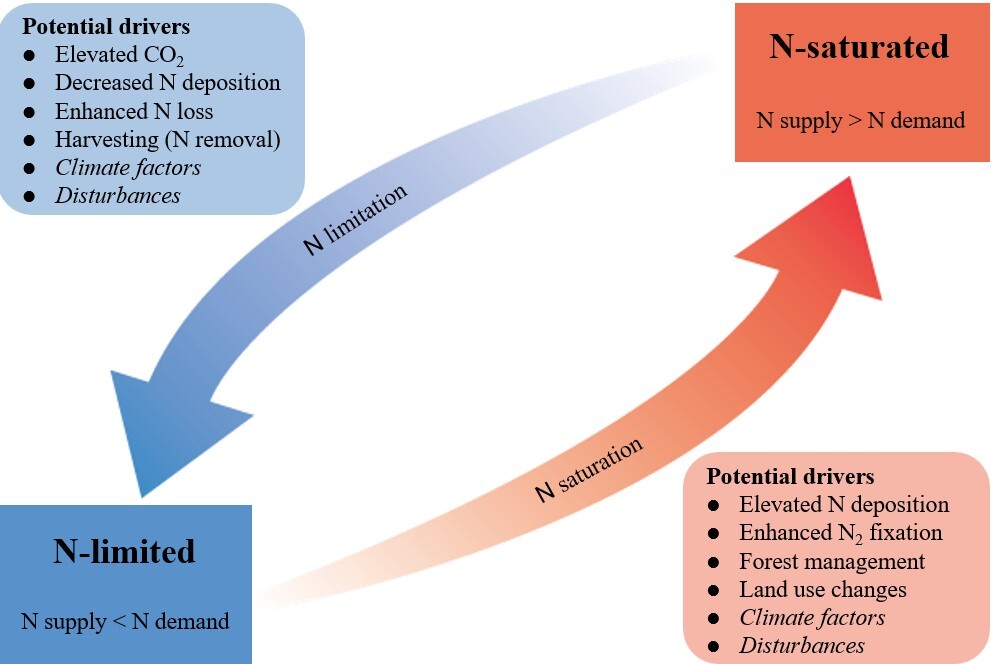
Figure 1. Nitrogen status in forest ecosystems under global environmental change, illustrating how different regions and environmental drivers may shift forests toward nitrogen saturation (red arrows) or nitrogen limitation (blue arrows) (Image by Geshere A. Gurmesa).
