


Mowing Increases Belowground Carbon Storage by Reshaping Grassland Plant Communities
A research team at the Institute of Applied Ecology (IAE) of the Chinese Academy of Sciences has reported that long-term mowing can substantially increase belowground carbon storage in temperate grasslands by reshaping plant community composition.
The results were published in Oikos.
Grasslands play a central role in the global carbon cycle, and the carbon stored in root systems often exceeds that in aboveground organs. Mowing is widely used in grassland management, particularly during autumn harvest, and long-term hay harvesting is known to influence plant growth and species composition. However, its consequences for belowground carbon stocks have remained poorly understood, partly because it is technically challenging to quantify root biomass for each species in a community.
Dr. Lü Xiaotao’s team conducted a long-term manipulaitve experiment at the Erguna Forest–Steppe Ecotone Research Station and quantified root biomass and carbon storage of each plant species in the grassland communities. The researchers found that belowground carbon stocks at the community level were more than twice of those stored aboveground. They also found that annual mowing increased belowground carbon storage by approximately 30 percent, and this pattern held true under both ambient N condition and the condition with nitrogen fertilizer application.
According to the study, the increases in belowground carbon storage were resulted primarily from the changes in species dominance. Mowing favored the growth of Carex duriuscula, a sedge species with a high root-to-shoot ratio. This means that a larger share of the plant’s biomass is allocated to roots, which contributes more to long-lasting carbon pools in the soil. As the proportion of this species rose substantially in mowed plots, the total root carbon stored at the community level increased correspondingly.
The study shows that mowing can affect grassland carbon sequestration by altering species composition and promoting plants that allocate more biomass belowground. The researchers note that such processes are particularly relevant under projected warmer and drier climate conditions, as well as in regions expected to face more frequent fire events. They suggest that mowing may help shift carbon from disturbance-prone aboveground pools into more stable belowground reservoirs.
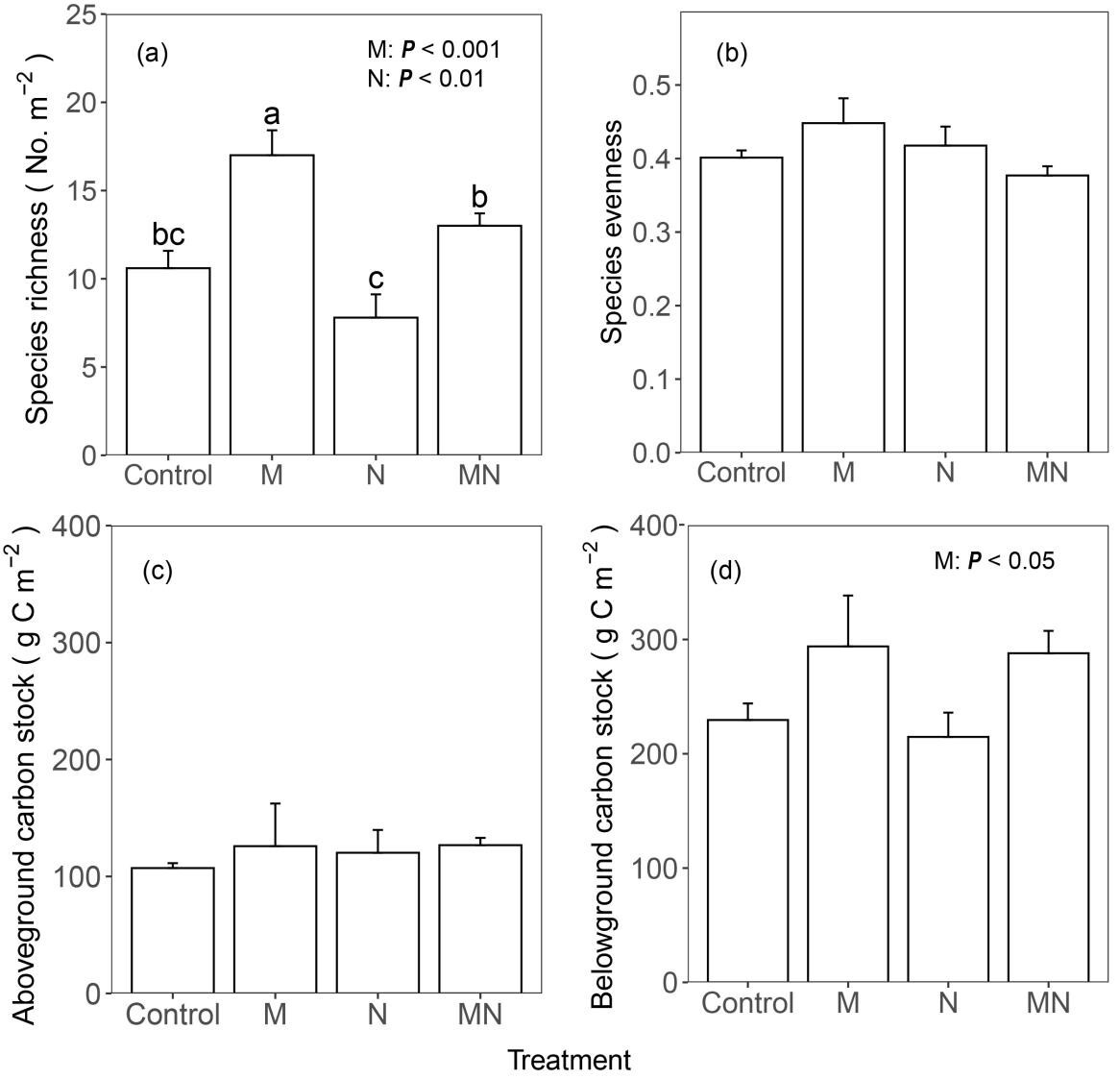
Figure 1. Effects of mowing and nitrogen addition on species richness, evenness, and community-level aboveground and belowground carbon storage (Image by Lü Xiaotao).
