


A Cold-Tolerant Soil Bacterium Shown to Inhibit Antibiotic Resistance Genes Under Freeze–Thaw Conditions
Researchers at the Institute of Applied Ecology of the Chinese Academy of Sciences have reported their findings on how a cold-tolerant soil bacterium can help curb the spread of antibiotic resistance genes (ARGs) in agricultural soils exposed to seasonal freeze–thaw cycles.
The findings were published in the Journal of Environmental Chemical Engineering.
The proliferation of ARGs in soil, largely derived from resistant bacteria, poses a dual threat to ecological stability and public health through horizontal gene transfer within microbial communities. In cold climates, recurring freeze–thaw cycles exacerbate this issue by physically restructuring soil and altering water movement. These changes alter the vertical distribution of ARGs and can significantly accelerate their leaching from surface horizons into deeper soil layers.
Associate Researcher ZHANG Xiaorong and doctoral candidate YANG Huimin conducted a two-year field experiment to evaluate whether the cold-tolerant soil bacterium Herbaspirillum huttiense (H. huttiense) could ameliorate the accumulation of ARGs via repeated freeze-thaw cycles in farmlands co-contaminated with oxytetracycline and enrofloxacin.
The researchers found that freeze–thaw cycles altered soil structure, facilitating the downward accumulation of ARGs into deeper soil layers, with their abundance increasing by up to approximately 50-fold in soils without microbial inoculation. However, inoculation with H. huttiense effectively curtailed the amplification of ARGs, limiting it to only about 6-fold.
The researchers identified several underlying mechanisms through which H. huttiense exerted its suppressive effect. Through niche competition, the inoculant directly reshapes the microbial community, enriching beneficial genera such as Hymenobacter while suppressing known ARG hosts like Flavisolibacter and Blastococcus. Concurrently, it reconfigures the topology of the microbial interaction network, severing key associations between ARGs and their potential hosts. Furthermore, H. huttiense modulates soil physicochemical properties (e.g., reducing total nitrogen and increasing electrical conductivity), thereby indirectly limiting the abundance of additional ARG‑hosting genera such as Nocardioides. This synergistic action ultimately leads to a marked reduction in the abundance of key tetracycline‑resistance genes, including tetW, tetQ, and tet(PA).
A profound shift in microbial community assembly was induced by H. huttiense: from stochasticity-driven to determinism-dominated. In ecological theory, deterministic processes refer to community changes influenced by environmental factors or species interactions, whereas stochastic processes arise from random dispersal and drift. Specifically, the contribution of heterogeneous selection, a key deterministic process, was markedly enhanced. This form of deterministic process indicates that H. huttiense imposed a more varied and stringent environmental filter across micro-habitats, selectively favoring certain microbial groups over others. This shift suggests that H. huttiense strengthened selective pressures within the microbial community, making the soil environment less favorable to bacteria that are commonly associated with hosting ARGs.
These findings demonstrate that the suppression of ARGs under freeze-thaw stress is achieved through the synergistic interplay between a reconfigured soil microbiome and its modified physicochemical environment. The researchers assert that precisely harnessing these microbe-mediated processes represents a viable strategy for the directional ecological engineering of soils, offering a targeted approach to suppress the environmental reservoir and dissemination of antibiotic resistance.
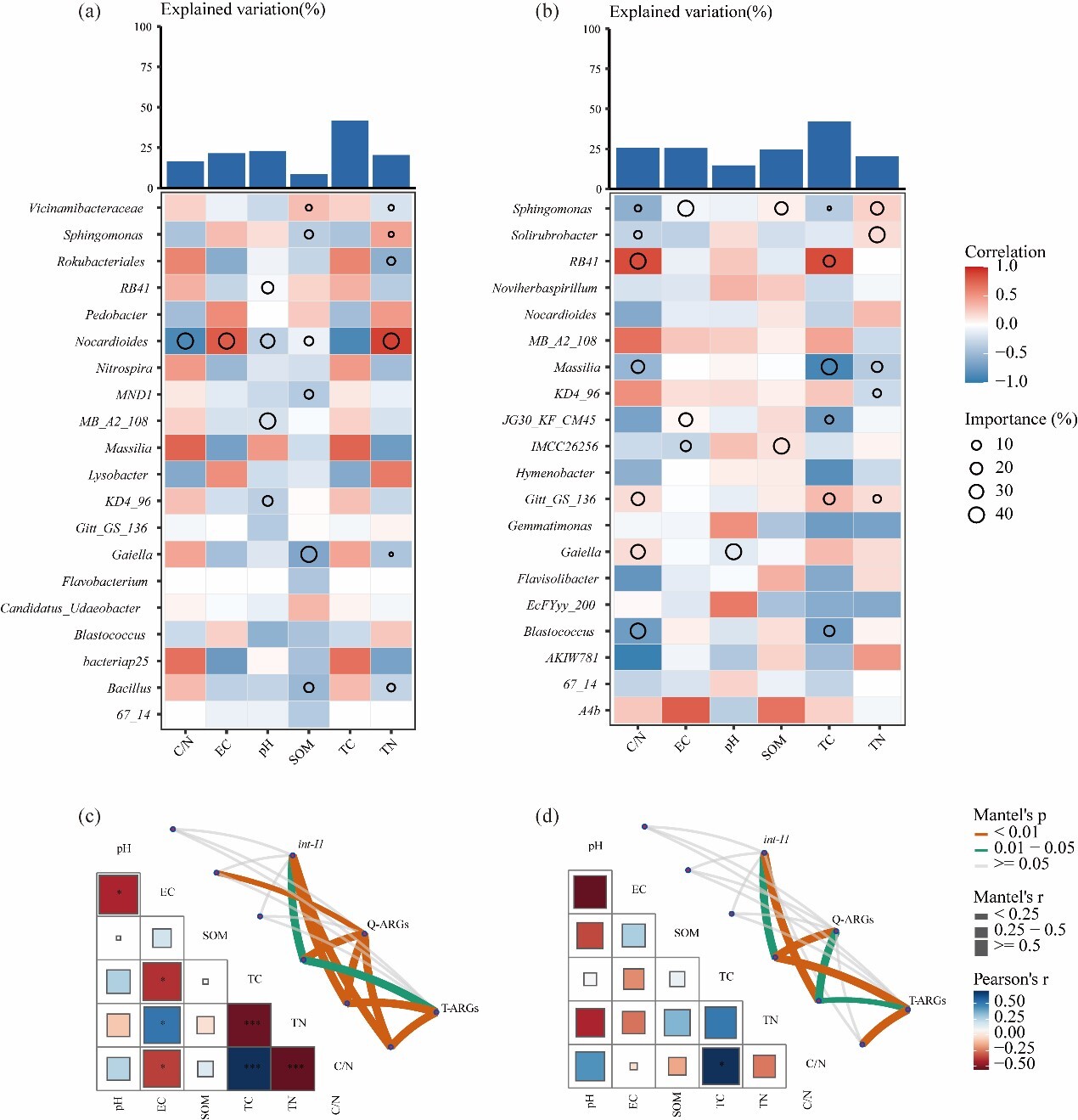
Figure 1. Relationships among ARGs, microbial communities, and environmental factors during the thawing period. Random forest models assessed correlations between soil variables and the relative abundance of dominant bacterial genera in the first year (a) and second year (b). Mantel test analyses examined correlations between ARGs and environmental factors in the first year (c) and second year (d) (Image by YANG Huimin).
