


Long-Term Field Study Finds Nitrogen Fertilization Weakens Non-Nitrogen Mineral Nutrition in Meadow Steppe Forage
A research team from the Institute of Applied Ecology of the Chinese Academy of Sciences (CAS) has uncovered how continued nitrogen fertilization undermines non-nitrogen mineral nutrition and the overall nutritional stability of forage in temperate grasslands. The results were published in the Journal of Ecology.
Grassland livestock production relies on the mineral nutrients in forage, which provide essential elements such as nitrogen, phosphorus, potassium, calcium, magnesium, and trace metals necessary for animal health. Nitrogen fertilization is widely used to improve forage production and restore degraded pastures. However, while nitrogen fertilization increases plant growth, it also alters the elemental composition of forage and frequently reduces plant species richness. These shifts have raised concerns about whether long-term nitrogen fertilization may weaken the availability and stability of non-nitrogen mineral nutrients at the community level, a question directly linked to forage quality and livestock nutrition.
Dr. Lü Xiaotao’s team conducted the study using a 10-year nitrogen addition experiment at the Hulunbuir meadow steppe. They examined the responses of forage non-nitrogen mineral nutrition with two indices: standardized mineral concentration (MC), a composite index summarizing how the concentrations of eight minerals collectively deviate from livestock minimum requirements under nitrogen addition, and expected mineral stability (MS), a unitless metric representing the community's capacity to maintain a sufficient multi-mineral supply through simulated species losses. Together, these indices quantify the integrative mineral status and its potential stability across nitrogen-addition gradients.
The researchers found that nitrogen addition significantly reduced both forage non-nitrogen mineral concentration and nutritional stability, with the negative effects intensifying over time. Across the nitrogen gradient, plant species richness showed a generally positive relationship with forage nutrition and nutritional stability. They explained that nitrogen-induced declines in species richness undermined the grassland’s capacity to supply non-nitrogen minerals, highlighting the importance of biodiversity conservation to maintain forage nutritional quality.
The study also identified a clear trade-off between forage yields and standardized concentration of non-nitrogen minerals along the nitrogen-addition gradient.
By clarifying how nitrogen fertilization alters the balance between forage yield and mineral nutritional quality, the study provides practical guidance for nutrient management in hay meadows.
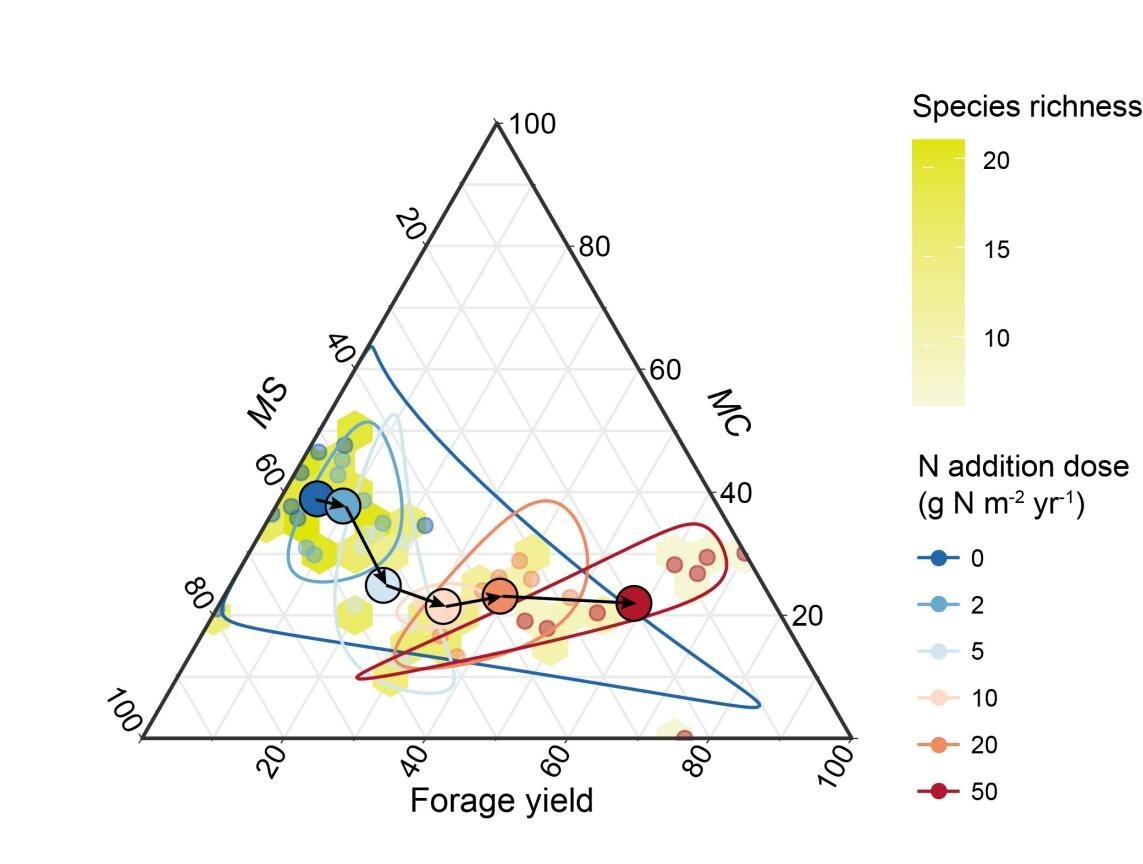
Figure 1. Trade-offs among forage yield, standardized non-nitrogen mineral concentration (MC), and expected mineral stability (MS) along the gradient of nitrogen addition (Image by ZHANG Xiaojing).
