


Native Vegetation Configuration Improves Stability of Restored Desertified Grasslands in Northern China
A two-year field study led by Associate Researcher WANG Yongcui from the Institute of Applied Ecology, Chinese Academy of Sciences, has identified how native vegetation configurations influence the recovery and stability of desertified grasslands at different stages of degradation.
The findings, published in Plant and Soil, indicate that restoration outcomes depend strongly on the initial severity of desertification, with moderately degraded grasslands showing the most pronounced response.
Grassland desertification is a major ecological challenge in semi-arid regions, where vegetation loss and soil degradation reduce biodiversity and impair ecosystem functions such as nutrient cycling and water retention. Restoring these systems requires not only reestablishing aboveground plant communities but also rebuilding soil seed banks, which consist of viable seeds stored in the soil and play a critical role in natural regeneration. However, how to select effective native plant combinations across different stages of degradation remains insufficiently understood.
To address this issue, the research team conducted in situ restoration experiments in the Zhanggutai area on the southern margin of the Horqin Sandy Land, a representative region of desertified grasslands in northern China. The study included lightly, moderately, and severely desertified sites, with treatments consisting of an unplanted control and two native species-addition configurations using locally adapted plants. Over 2024 and 2025, the researchers monitored aboveground vegetation and soil seed bank characteristics.
The researchers found that the effectiveness of native species addition varied significantly with the degree of desertification. Moderately desertified grasslands showed the strongest and most sustained improvements, with substantial increases in plant species richness, vegetation cover, and density under near-natural vegetation configurations. These treatments also significantly enhanced the species composition similarity between aboveground vegetation and soil seed banks, indicating a tighter coupling between the two components and a stronger capacity for self-regeneration. In contrast, lightly desertified grasslands exhibited limited response to restoration treatments, largely due to the competitive dominance of existing species, which constrained the establishment of newly introduced plants. Severely desertified grasslands responded more slowly, as harsh abiotic conditions such as low soil fertility and water deficiency limited vegetation recovery.
Further analysis showed that soil seed bank diversity increased gradually under restoration treatments, and that improvements in community structure were associated with the incorporation of key native species, including Lespedeza davurica and Allium ramosum. The researchers also noted that combining shrubs and herbaceous species enhanced functional complementarity, thereby improving overall ecosystem stability and resistance to disturbance.
The study highlights that moderately desertified grasslands represent a critical time-window for ecological restoration, where targeted native vegetation configurations can rapidly rebuild plant communities and strengthen vegetation–seed bank linkages. While restoration in lightly and severely degraded systems faces constraints from biotic competition and abiotic stress, respectively, the findings emphasize the importance of tailoring restoration strategies to site-specific conditions.
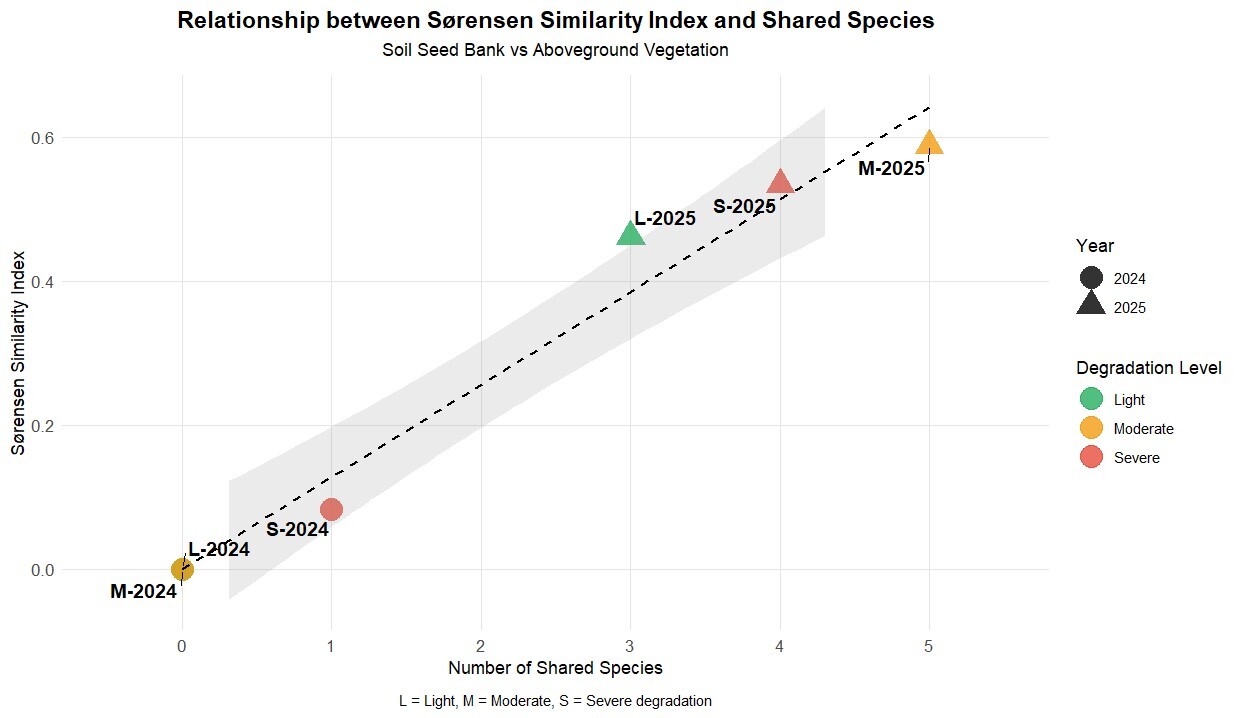
Figure 1.Relationship between the Sørensen similarity index and the number of shared species between soil seed banks and aboveground vegetation in lightly, moderately, and severely desertified grasslands during 2024 and 2025 (Image by WANG Yongcui).
