


Long-term Study Examines How Nitrogen Input and Hay Cutting Interact to Shape Grassland Productivity
A decade-long field experiment in northern China has found that low-level nitrogen addition increases grassland biomass only under non-harvested conditions, while its effect disappears when grasslands are subjected to annual hay cutting.
The study, led by researchers from the Institute of Applied Ecology, Chinese Academy of Sciences, was published in New Phytologist.
Aboveground productivity, defined as the aboveground biomass produced annually by plant communities, underpins the ecological and economic functions of natural grasslands, including forage supply and carbon cycling. Nitrogen is a key limiting nutrient in many terrestrial ecosystems, and previous studies have shown that nitrogen inputs can enhance plant growth. However, most of this evidence has been derived from experiments involving high nitrogen application rates or grasslands without human use. Whether low-level nitrogen addition can sustain productivity under intensive use, such as annual hay harvesting, has remained unclear.
To address this question, Dr. LÜ Xiaotao's research team analyzed 10 years of observational data collected from 2015 to 2024 at a meadow steppe in Hulunbuir. The experiment compared enclosed grasslands, which were protected from harvesting, with grasslands subjected to annual hay cutting in the late growing season. A low nitrogen addition treatment of 2 grams of nitrogen per square meter per year was applied to evaluate its long-term effects on plant community structure and biomass production.
The researchers found that low-level nitrogen addition increased the cumulative aboveground biomass production by 25% over the decade in enclosed grasslands. In contrast, no significant increase was observed in hay-cutting grasslands under the same level of nitrogen input. This difference was primarily linked to how dominant plant species responded to nitrogen under different management regimes.
In hay-cutting grasslands, annual hay harvesting over 10 years led to a marked increase in species richness, which refers to the number of plant species present in a community. At the same time, the abundance and individual biomass of dominant species declined significantly. The researchers noted that although higher species richness can contribute positively to productivity, this effect was not sufficient to offset the reduction in biomass from dominant species, which typically contribute the largest share of total production.
Further analysis showed that the absence of productivity gains under nitrogen addition in hay-cutting grasslands was closely associated with reduced population size and individual growth of dominant species. These findings indicate a trade-off between species richness and the abundance of dominant species in determining total productivity. In ecological terms, this trade-off reflects the balance between biodiversity and biomass production, where increases in diversity do not always translate into higher total output if key productive species decline.
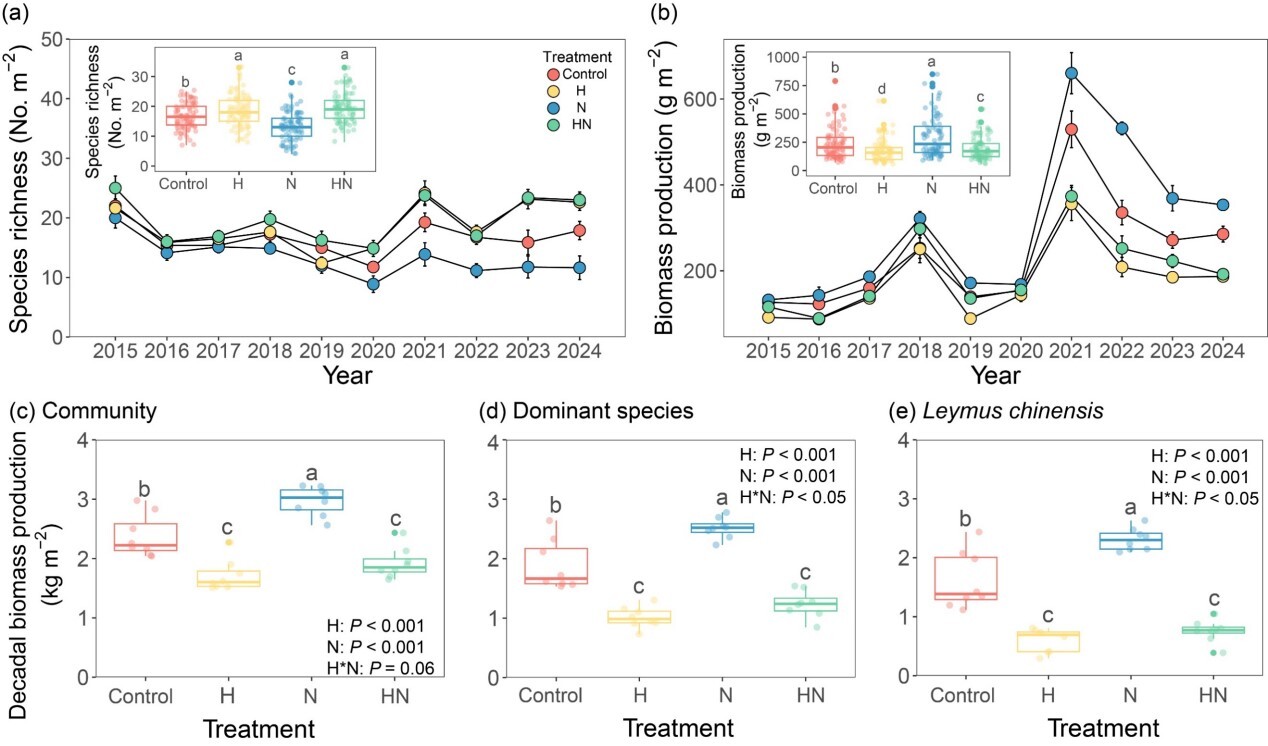
Figure 1. Interannual dynamics of species richness (a) and aboveground productivity (b) in a meadow steppe under factorial treatments of nitrogen input and annual haying, and cumulative aboveground biomass production of the community (c), dominant species (d), and Leymus chinensis (e) over a 10-year period (Image by LV Xiaotao).
