

RESEARCH NEWS
Study Explores How Microbes in Different-sized Soil Aggregates Adjust Carbon and Nitrogen Use Under Nitrogen Enrichment
Researchers from the Institute of Applied Ecology of the Chinese Academy of Sciences have identified distinct strategies used by soil microorganisms living in aggregates of different sizes to cope with increasing nitrogen inputs, providing new insights into microbial regulation of carbon and nitrogen cycling in grassland ecosystems.
Their findings were published in the journal Catena.
Atmospheric nitrogen deposition, largely driven by fossil fuel combustion and agricultural activities, has risen substantially in recent decades and has become an important component of global environmental change. Additional nitrogen can alter the balance between carbon and nitrogen resources in soils, affecting the activity of microorganisms that play a central role in decomposing organic matter and recycling nutrients. Microbial carbon use efficiency (CUE) and nitrogen use efficiency (NUE), which describe the proportions of absorbed carbon and nitrogen that microbes allocate to growth rather than loss, are considered key indicators of these ecological processes. However, soils are composed of aggregates of different sizes that create distinct microhabitats, and it has remained unclear whether microorganisms living in these confined spaces respond to nitrogen enrichment in the same way.
To address this question, Dr. Wang Zhirui and Researcher Li Hui from the Institute of Applied Ecology collaborated with researchers from Yangzhou University and Hebei University to conduct a study using a long-term nitrogen addition experiment at the Erguna Forest-Steppe Ecotone Ecosystem Research Station.
The researchers found that microbial communities inhabiting different soil aggregates adopted contrasting adaptive strategies when nitrogen addition altered the balance between available carbon and nitrogen resources. In macroaggregates, which are soil particles larger than 250 μm and generally contain relatively fresh organic matter, microorganisms responded to increasing carbon limitation by raising their CUE while lowering their NUE. This adjustment allowed the microbial community to maintain a relatively constant biomass stoichiometry, a phenomenon known as stoichiometric homeostasis.
By contrast, microorganisms living in microaggregates smaller than 250 μm displayed a non-homeostatic strategy. Rather than changing their CUE and NUE, these microbial communities adapted to nitrogen-rich conditions by altering community composition and storing excess nitrogen within their biomass. The researchers also found that microbes in microaggregates generally maintained higher CUE than those in larger aggregates, reflecting their long-term adaptation to environments where available substrates are more limited.
The findings suggest that the response of soil microorganisms to nitrogen enrichment depends strongly on the physical structure of the soil itself. Adaptive strategies based on either maintaining internal chemical balance or flexibly adjusting microbial composition can ultimately influence how carbon and nitrogen move through terrestrial ecosystems.
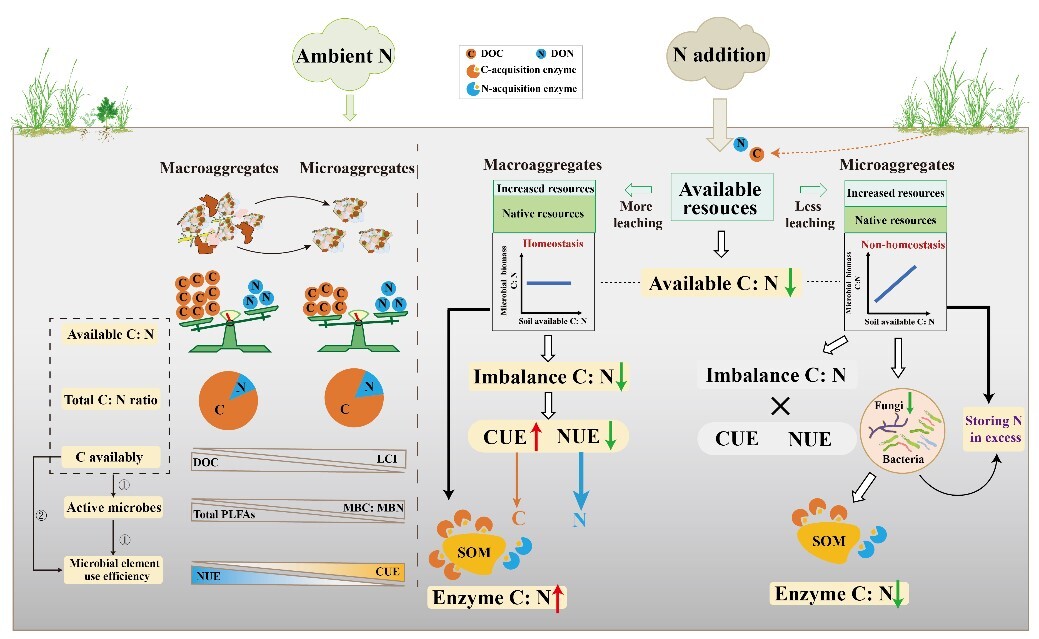
Figure 1. A conceptual diagram illustrating the effect of N addition on microbial CUE and NUE within different aggregate size fractions and the underlying mechanisms (Image by WANG Zhirui).
