

RESEARCH NEWS
-
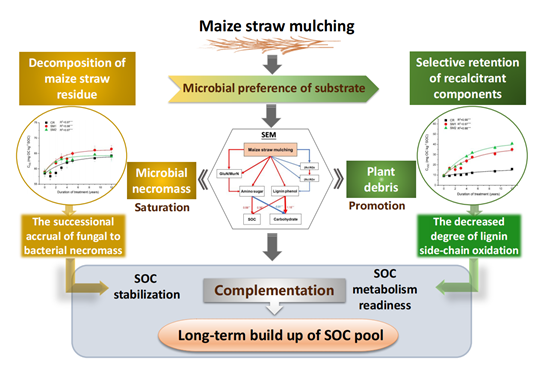 The Build-up of Soil Organic Carbon Pool in Conservation Agriculture is Determined by the Complementation between Microbial- and Plant-derived ComponentsLI Yi, a doctoral candidate of the Soil and Environmental Biochemistry Team of the Institute of Applied Ecology, Chinese Academy of Sciences, recently completed a research quantifying the dynamic changes of amino sugars and lignin phenols in soil over 12 years of no-tillage and straw mulching at the National Farmland Ecosystem Observation Research Station in Shenyang, Liaoning Province. The contribution mechanism of microbial-derived and plant-derived components to SOC sequestration and stabilization under conservation tillage was investigated, laying the foundation for enhancing soil organic matter and comprehensive management of Northeast farmland.Apr 18, 2023
 -
Quantitative Analysis of the Link between Forest Structure and Albedo in the Temperate Secondary Forest EcosystemLi Shuangtian, a doctoral candidate of the Qingyuan Ker Towers Research Team of the Institute of Applied Ecology, Chinese Academy of Sciences, recently completed a study. They continuously observed forest albedos and FAPAR, as well as seasonal changes in canopy and understory in the temperate forests using Qingyuan Ker Towers (three flux towers in a watershed; natural mixed broadleaved forest, T1-MBF; natural Mongolian oak forest, T2-MOF; larch plantation forest, T3-LPF), and demonstrated a comprehensive analysis.Apr 07, 2023
-
Climate Extremes and Forest Age Mediate Drought-induced Forest Mortality in Northeast ChinaMA Tianxiao, Associate Researcher of the Landscape Process Research Team of the Institute of Applied Ecology, Chinese Academy of Sciences, recently completed a research quantifying drought-induced mortality rates of Northeast China's forests at tree species and regional scales through statistical fitting the relationship between Rainfall Use Efficiency (RUE) and precipitation, the relationship between drought-induced forest mortality and forest age, and the relationship between RUE and drought index (more specifically, the Standardized Precipitation Evapotranspiration Index, SPEI) in Northeast China.Apr 06, 2023
-
Bud Banks Confer the Rapid Grassland Recover Following Extreme DroughtTo address this knowledge gap, a research team from the Institute of Applied Ecology of the Chinese Academy of Sciences conducted a four years extreme drought followed by three years recovery and explored the impact of the effects of drought and recovery on aboveground net primary productivity (ANPP) in a grassland of northern China. Surprisingly, the researchers found that ANPP in the drought-plots recovered to the level of control-plots within a year after extreme drought.Mar 29, 2023
-
Changes in Dominance of Plant Species with High Stoichiometric Plasticity Exacerbate Community Nitrogen–Phosphorus ImbalanceThe researchers found that nitrogen addition led to a significant increase in N:P ratio of the plant community as a whole, and the community nitrogen and phosphorus imbalance could be attributed to the variation in plant species composition.Mar 28, 2023
-
Scientists Reveal Importance of Acetobacterium in Anaerobic Biohydrogenation of 1,3-Butadiene to 1-ButeneResearch Scientists YANG Yi and YAN Jun of the Institute of Applied Ecology, Chinese Academy of Sciences recently established a BD anaerobic biotransformation microcosm using river sediment as the inoculation source.Mar 01, 2023
-
Researchers Isolate Two New Organohalide-respiring Sulfurospirillum StrainsResearchers Isolate Two New Organohalide-respiring Sulfurospirillum StrainsSulfurospirillum, widely distributed in natural environments, is a class of anaerobic microbes with the ability to reduce sulfur and sulfur oxides. Some species of the genus can make use of tetrachloroethylene and trichloroethylene, the organochlorine pollutants which are common in the global subsurface environment, as electron acceptors. This metabolic mode has also been called organohalide respiration.Mar 01, 2023
-
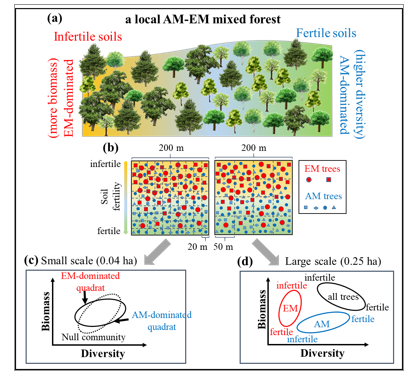 New mycorrhizal dominance mechanism drives the scale-dependent biodiversity-ecosystem functioning relationshipsIn a recent study published in Ecological Monographs, researchers from the Institute of Applied Ecology Chinese Academy of Sciences and their collaborators propose a mycorrhizal dominance mechanism to address the scale-dependence issue in BEF studies (Figure 1). They predicted that the scale-dependent relationships between plant diversity and biomass carbon content observed in natural forests were mostly driven by the distribution patterns of arbuscular- (AM) and ecto-mycorrhizal (EM) tree species, together with soil heterogeneity (Figure 1).Mar 01, 2023
 -
Impact of Recurrent Drought on Grassland Productivity is Mediated by Ratio of Grasses to ForbsIn view of this, Dr. LUO Wentao, associate researcher of the Eco-stoichiometry research group of the Institute of Applied Ecology, Chinese Academy of Sciences, led a study examining grassland natural restoration following two consecutive years of extreme drought manipulation, and explored the carry-over effects of the extreme drought event on plant community structure and function.Feb 07, 2023
-
Study Sheds Light on the Specificity of Root Exudate Types on Soil Organic Carbon DecompositionSoil organic carbon is critical for climate regulation and ecosystem stability. Its decomposition can be significantly influenced by plant root exudates via the priming effect. However, the understanding of how specific compounds of root exudates influence soil C decomposition via the priming effect is still lacking.Feb 07, 2023
