

RESEARCH NEWS
Soil Acidity Influences Carbon Removal Efficiency of Enhanced Rock Weathering, CAS Study Finds
A study by researchers at the Institute of Applied Ecology (IAE) of the Chinese Academy of Sciences (CAS) has found that soil acidity plays a critical role in determining the effectiveness of enhanced rock weathering (ERW) and the accuracy of carbon removal estimates.
The findings were published in the journal Environmental Science & Technology.
Enhanced rock weathering is an emerging carbon dioxide removal (CDR) technology that aims to remove atmospheric carbon dioxide by applying silicate minerals to soils. During weathering, these minerals release alkaline cations, which can react with carbon dioxide to form dissolved inorganic carbon and contribute to long-term carbon storage. Current ERW carbon removal assessments, however, mainly estimate carbon sequestration based on the release of calcium ions (Ca²⁺) and magnesium ions (Mg²⁺), assuming that their release mainly results from carbonic acid-mediated weathering and that each mole of divalent cation released corresponds to the fixation of two moles of carbon dioxide. This approach does not fully consider the role of soil acidity and non-carbonic sources of protons (H⁺) in mineral weathering, potentially leading to an overestimation of ERW carbon removal potential.
To address this issue, researchers from the ecosystem carbon and nitrogen cycling and stable isotope technology application team at IAE, including Assistant Researcher SU Chenxia, Researcher FANG Yunting and Researcher KANG Ronghua, conducted a long-term soil column experiment using wollastonite in agricultural soils with different acidity levels. Measurements of dissolved ions, carbon formation and carbon dioxide emissions allowed them to quantify how soil conditions influenced the efficiency of ERW.
The researchers found that lower soil pH accelerated wollastonite dissolution but did not proportionally increase carbon removal efficiency. Specifically, cation-based estimates of carbon dioxide removal were 1.5 to 3.1 times higher than the actual inorganic carbon formed. Further analysis showed that the source of protons influences whether mineral weathering is effectively coupled with carbon removal. In acidic soils, protons from non-carbonic sources promoted rapid wollastonite dissolution and increased calcium release, but this process did not consume atmospheric carbon dioxide. In contrast, weathering driven by carbonic acid contributed to inorganic carbon formation and effective carbon removal.
The study showed that each mole of divalent cations released during wollastonite weathering resulted in the fixation of only 0.63 to 1.30 moles of carbon dioxide, substantially lower than the theoretical value of two moles. When the experimentally measured carbon fixation efficiency range was applied to global agricultural ERW carbon sink estimates, the researchers found that conventional cation-based approaches could overestimate carbon removal potential by approximately 34 percent to 67 percent.
The researchers also found that applying wollastonite to acidic soils promoted the dissolution of carbonate minerals introduced with the amendment and accelerated soil organic carbon mineralization, resulting in additional carbon dioxide emissions. After accounting for these emissions, the researchers found that net carbon removal ranged from 0.07 grams of carbon per kilogram of soil in acidic conditions to 0.46 grams in alkaline soils.
The researchers suggest that soil acidity should be incorporated into future ERW carbon accounting frameworks to improve carbon removal assessments.
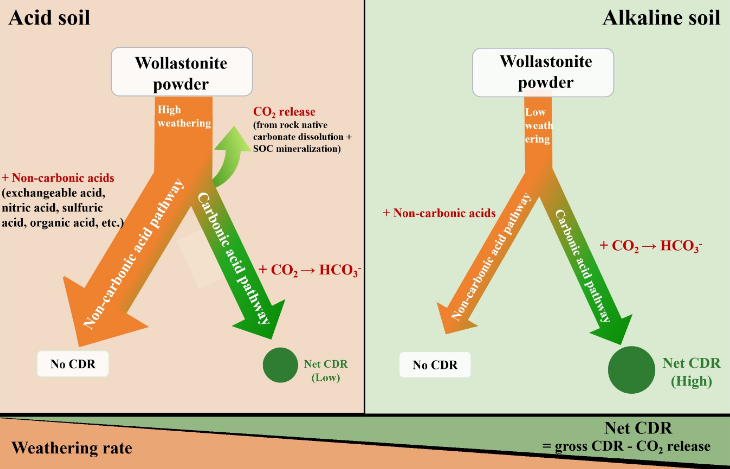
Figure 1. Schematic diagram showing how soil acidity affects carbon removal efficiency during enhanced rock weathering (Image by SU Chenxia).
