

RESEARCH NEWS
-
 Vitamin C Production Byproduct Found to Improve Maize Yield through Soil and Microbial ProcessesThe vitamin C industry may offer an unexpected resource for sustainable agriculture, according to a new study by researchers from the Institute of Applied Ecology of the Chinese Academy of Sciences. The team found that a fermentation byproduct generated during vitamin C production can improve soil biological activity and crop performance, increasing maize grain yield by 8.26 to 13.46 percent under field conditions.Jun 17, 2026
-
 Study Explores How Microbes in Different-sized Soil Aggregates Adjust Carbon and Nitrogen Use Under Nitrogen EnrichmentResearchers from the Institute of Applied Ecology of the Chinese Academy of Sciences have identified distinct strategies used by soil microorganisms living in aggregates of different sizes to cope with increasing nitrogen inputs, providing new insights into microbial regulation of carbon and nitrogen cycling in grassland ecosystems.Jun 17, 2026
-
Seven-Year Field Experiment Identifies Threshold Response of Grassland Arthropod Communities to Phosphorus EnrichmentNon-linear responses of plant phosphorus content and arthropod community composition along the gradient of phosphorus addition rates.Jun 04, 2026
-
 Study Examines How Global Change Factors Alter Multi-Element Composition of Grassland LitterResearchers at the Institute of Applied Ecology of the Chinese Academy of Sciences (CAS) have investigated how multiple global change factors influence the chemical composition of plant litter in temperate grasslands, finding that drought and nitrogen addition are the primary drivers of changes in litter multi-element characteristics, while variation within species plays a dominant role in shaping community-level responses.Jun 03, 2026
-
 Soil Viruses Linked to Carbon Storage Through Microbial Turnover and MetabolismResearchers at the Institute of Applied Ecology of the Chinese Academy of Sciences (CAS) have identified how soil viruses influence soil organic carbon accumulation and long-term storage in farmland ecosystems, revealing that viral interactions with microorganisms can promote carbon sequestration through both host-cell lysis and metabolic reprogramming.Jun 03, 2026
-
Study Defines Organic Fertilizer Substitution Limits and Trade-offs in Smallholder Farming SystemsResearchers from the Institute of Applied Ecology of the Chinese Academy of Sciences have quantified the extent to which organic fertilizers can replace chemical inputs in smallholder farming systems, and how different organic recycling models affect both nutrient efficiency and farm income.May 27, 2026
-
 Too Much Nitrogen May Leave Trees More Vulnerable to DroughtLong-term nitrogen addition can make young and mature trees more vulnerable to drought, but through different physiological routes.May 08, 2026
-
Trees May Have a Third Way to Save NitrogenA 15-year experiment in northern China suggests trees use a hidden nitrogen-saving pathway that becomes increasingly important as forests mature.May 08, 2026
-
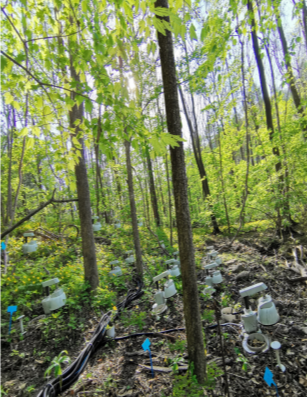 New Study Explains Spatial Patterns of Soil Nitrogen Emissions Across Forest HillslopesThe study fills an important knowledge gap in high-frequency observations of forest hillslope N emissions and provides new insights into the spatial heterogeneity of forest N cycling under changing environmental conditions.May 08, 2026
-
 Wollastonite-Enabled Fermentation System Boosts Biohydrogen Yield and Captures CO2Researchers from the Institute of Applied Ecology of the Chinese Academy of Sciences have developed a fermentation process that simultaneously enhances biohydrogen production and sequesters carbon dioxide within a single system. The study, led by Dr. LI Weiming, was published in Chemical Engineering Journal.May 08, 2026
